
ADHD - Attention Deficit Hyperactivity Disorder
SEED Early Childhood Educational Blog
Did you know that ADHD is treatable? Have you ever wondered what ADHD is? Why is it so prevalent today? Take a deep dive into ADHD in this post.
Keywords: ADHD ADHD Causes ADHD Alternative ADHD Treatments Attention Deficit Hyperactivity Disorder Behaviour
Author SEED Early Childhood
13 March 2026




ADHD has been around for hundreds of years, specifically described at least 200 years ago. In the last 35 years, ADHD has gained research and media attention, and in the last ten years, ADHD has become the most common neurological disorder in adults and children.
Attention Deficit Hyperactivity Disorder (ADHD) is a neurological disorder, characterised by lack of attention and impulsivity. Although described 200 years ago, ADHD has gained popularity in the media and research in recent years and is currently the most common neurological disorder in the world. [1][6]
In the UK, ADHD affects roughly 4 in 100 people and 4-12% of school-aged children worldwide. ADHD is classed as an early-onset disorder because it develops during early childhood. Although some research suggests symptoms may not be seen until the child is around 3 years old. [6][11][12][14]
ADHD and the Brain
ADHD is categorised as a neurological, neurodevelopmental condition because it affects the brain. The brain of a child with ADHD has developed differently from that of a neurotypical child, and this difference is described as a neurodivergence. ADHD is a complex disorder and affects many different parts of the brain, such as neurotransmitters that deal with dopamine and adrenaline. Research connects ADHD to cognitive, functional and abnormalities in the brain. Because ADHD affects the function of the brain, it can also affect behaviour and areas of the brain which control certain abilities called executive function. [1][6][11]
EXECUTIVE FUNCTION
Executive functions are skills like:
Short-term memory
Flexible thinking
Self-regulation
These skills are foundational for a child’s ability to organise, pay attention, focus, self-assess and manage emotions. Divergence in the development of executive function can affect processes such as:
Decision making
Emotional regulation
Social competence
Learning
While there is a large amount of research on executive function and ADHD, it is also the case that not all children with ADHD show impairment of executive functioning. Although ADHD is a complex disorder, there are treatments that can significantly reduce symptoms [1][7][13]


ADHD is a complex disorder and affects many different parts of the brain.
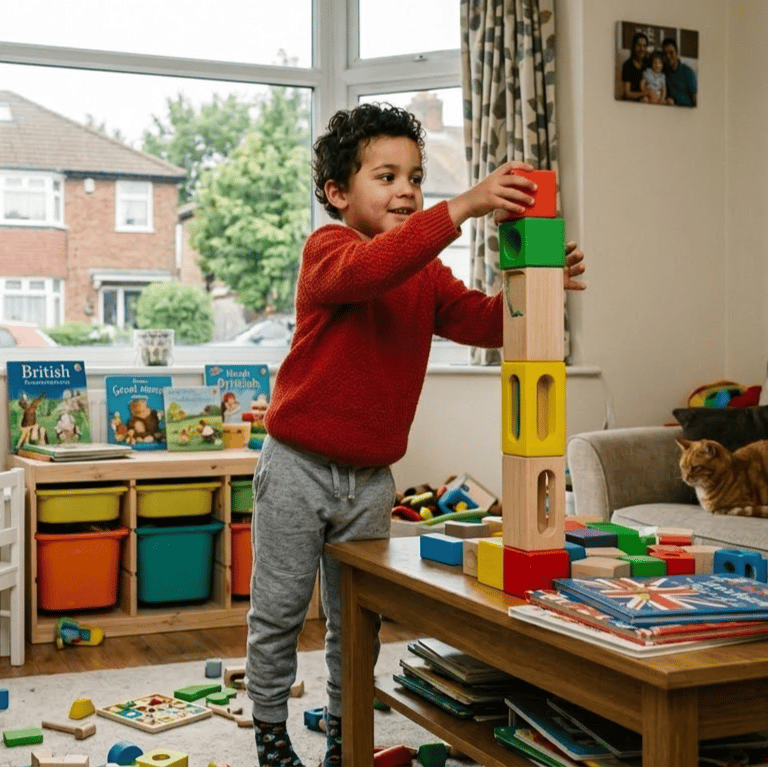
Image credit: AI. Boy with ADHD plays with blocks at home.
Symptoms of ADHD
The behaviours that may result from a child having ADHD are:
Being unable to maintain concentration
The child does not seem to listen when directly spoken to
Inability to give close attention to details
The child's mind wanders
Excessive movement
Hyperfocus
Twitching or tapping
Child interrupts others
Impatience
Dangerous behaviour
Taking risks
'Careless' mistakes in schoolwork or other activities
Difficulty sustaining tasks
Some mood symptoms
Emotional dysregulation
Anxiety
Low self-esteem
Difference in sensory processing.
There are particular groups which are believed to be more at risk of ADHD than others:
Babies born prematurely (before the 37th week)
Babies with a low birth weight
Babies with epilepsy
Babies who experienced brain trauma in the womb
Children who experienced brain damage from injury
Some studies also explore socioeconomic factors as risk factors.[7][8][9][12][14]
ADHD and Genetics
Although there are possible risk factors (as stated earlier), the exact cause of ADHD is still unknown. Two additional considerations are genetics and environmental factors. Some researchers suggest that genetics is foundational for the occurrence of ADHD. Stating that genetics supported determining over 80% of cases they studied. Studies on twins highlight the genetic link, with a 90% rate for ADHD occurrences. In the case of environmental influences, some researchers suggest that the control of the environment could reduce symptoms. For example, calm lighting and removal of distractions.[1][6]
Identification
It is common for young children to be very active. In most cases, this behaviour is normal, and as they get older, this decreases. If you think your child has ADHD, speak to your GP. Children can get an early diagnosis; however, symptoms may be identified when the child enters an educational setting like a nursery or school. The contribution of educators and teachers is crucial for a child’s diagnosis. ADHD can be missed or misdiagnosed, and the child may reach secondary school before their challenges are made apparent. ADHD may be more noticeable because, in an educational setting, a child may be required to sit still and pay attention for periods of time, and observers can compare their behaviour with peers of the same developmental age. [8][10][11]
Types of ADHD
There are three subtypes of ADHD: Hyperactive-impulsive, Inattentive, and Combined. ADHD can have various levels of severity; however, a large number of individuals have persistent symptoms characterised by inattention and hyperactivity-impulsivity demonstrated across two or more settings, such as at home or school. [6][7][8]
Diagnosis
For the right treatment and interventions to take place, there needs to be an accurate identification and diagnosis of ADHD. There are international standards for ADHD diagnosis. For example, the core symptoms are expected to be present in multiple settings. Several inattentive or hyperactive impulsive symptoms should be present before the child's 12th birthday. The need to be evidence that symptoms negatively interfere with the social and educational areas of their life.
Examples of behaviour for the 3 ADHD subtypes:
HYPERACTIVITY-IMPULSIVITY
The child may be nervous and restless; they may seem to always be ‘on the go’. They may struggle to sit down quietly for long periods. When they do sit, they may fidget. They may talk excessively and may interrupt others' conversations or games. They may have difficulties waiting for their turn. They may show immaturity and not set physical boundaries. They may display destructive behaviours. Hyperactivity-impulsivity is the primary symptom of ADHD in many pre-school-age children.
INATTTENTION
The child may be easily distracted and may also daydream and be imaginative. They may struggle to pay attention to detail or make silly mistakes when working or playing; they may not finish tasks and may find it difficult to maintain attention for long periods. They may be forgetful and disorganised, and often lose their belongings. Inattention has been found to be common during ages 5-9 years old.
COMBINED
A child who experiences symptoms from both the inattention and hyperactivity-impulsivity categories. The combined category is the most common type of ADHD. [2][6][8][10]
DIAGNOSIS: BOYS AND GIRLS
ADHD is more frequently diagnosed in boys, and research suggests girls are being underdiagnosed. It is believed that girls are underrepresented in referrals. This could be because some girls present inattentive symptoms and not hyperactivity. Others suggest girls and women are less diagnosed because males are researched more than females. Individuals with ADHD can also mask their behaviours, and it is thought that girls may mask their differences better than boys. The impact of a missed diagnosis can be significant. Without treatment, children with ADHD can develop anti-social behaviour, learning difficulties and emotional problems. [7][10][11]
Other Conditions and ADHD
One study highlighted the importance of ADHD treatment in the context of co-occurring conditions. Up to 80% of children with ADHD will have another condition, such as motor, language, social disorders or another neurodevelopmental disorder. Other common conditions associated with ADHD are:
Anxiety
Depression
Oppositional Defiant Disorder (ODD)
Autism Spectrum Disorder (ASD)
Epilepsy
Tic Disorders (TD)
Sleep Disorders
Learning Difficulties [4][6][7][10][11]
Social-Emotional Impact
Research suggests hyperactivity-impulsivity is closely linked to peer rejection and negative social interactions. Children with ADHD may show less resilience and struggle with interpersonal skills. Children may develop coping strategies, such as confrontation and aggression, which further affect their relationships. This may lead to low self-esteem and social isolation. [7]
One study exploring Health Related Quality of Life (HRQoL) found that neurotypical children ranked poorer than their neurotypical peers. The study highlighted the importance of considering the child’s well-being, not only their ADHD. [3]


Image credit: AI. Girl with ADHD sits at circle time.
Educational Settings
All children may feel restless and distracted from time to time, but children with ADHD may experience this daily and struggle significantly. If left untreated, ADHD can affect a child’s mental health and affect their ability to learn. If you are concerned about your child, speak to your child’s educator or teacher.
Research has shown that raising ADHD awareness among educators and teachers is important. In an educational setting, children with ADHD may be misunderstood and wrongly punished for their condition. They may also feel behind their peers and may benefit from learning support or adjustments. The setting will have a Special Education Needs and Disabilities Coordinator (SENDCO) who works with external specialists to provide adaptations to the educational environment. Adjustments for a child with ADHD can support a child to manage their symptoms, such as:
A fixed routine
Tasks that are broken down
Clear boundaries and expectations for behaviour
Clear concise instructions
Stimulating activities
A reward system
A seat with limited distractions
A quiet space
Frequent breaks
Frequent positive feedback [6][10][11][12]
Treatments
ADHD early intervention is very important because ADHD is a treatable condition, and evidence shows that interventions can significantly improve a child’s symptoms and severity. Without treatment, children with ADHD can experience limitations in their ability to thrive and an increase in harmful and dangerous behaviours. To date, there is no specific treatment or diagnostic test for ADHD. Every child with ADHD is unique and will require a specific, tailored plan. In the world of research, debates about approaches to treating ADHD come down to the classification of the disorder. However, a variety of therapeutic methods have been successful in reducing symptoms. Stimulant medication and behavioural therapy are currently the first line of ADHD treatment, complemented by psychoeducation. [2][5][6][7][8]
MEDICATION
There are two types of ADHD medications: stimulants and non-stimulants. Both types are understood to change the chemical balance of the brain. Like all medication stimulants and non-stimulants come with possible side effects. [12]
THERAPY
Behavioural therapy, also referred to as Cognitive therapy or Cognitive-Behavioural Therapy (CBT), is strongly recommended for children with ADHD. Research has shown that behavioural therapy is just as effective as low-dose stimulant medication. CBT can provide a child with strategies to manage their symptoms, especially those connected to cognitive and behavioural functioning. As a talking therapy, it involves learning how to cope with negative thoughts. This can also involve environmental modifications in educational environments and at home to support the management of ADHD symptoms. There can also be support for parents on how to improve their child’s behaviour. [6][11][12].
SOCIAL SKILL TRAINING (SST)
Social Skills Training (SST) is an effective psychosocial intervention that focuses on social skills, listening skills, problem-solving, self-control, and the management and expression of emotions. SST is recommended to support children’s social interactions and improve their ability to communicate, reducing social isolation. [2][7][10]
EXERCISE
There is evidence that exercise can reduce the symptoms of ADHD. Regular exercise is encouraged and has been found to specifically reduce hyperactivity-impulsivity and improve focus. [7][10][12]
DIETARY
Diet and supplementation therapies are used as a treatment for ADHD. Having a healthy, balanced diet can help a child manage their symptoms. Adherence to specific diets, such as oligoantigenic or additive-free diets, can be recommended by professionals. [5][6][12]
NEUROFEEDBACK THERAPY
Neurofeedback has been a research topic for about 70 years. Neurofeedback, or EEG biofeedback, is a non-invasive therapy that helps the conscious control of brain waves. Research has shown that the therapy improves ADHD symptoms. Three common neurofeedback training procedures are found to be effective and specific: Theta/Beta (TBR), Sensori-Motor Rhythm (SMR), and Slow Cortical Potential (SCP). A study found that neurofeedback for ADHD is an alternative to medication. However, there is debate about the effectiveness of Neurofeedback within the scientific community. [6][15]
PSYCHOEDUCATION
Psychoeducation is a teaching program delivered by a mental health professional for those diagnosed with ADHD, their parents and their educators and teachers. The professional teaches on ADHD, symptoms, daily impact and management strategies. Training for parents can complement their child’s CBT therapy and focuses on behaviour management, how to provide structure and organisation and child-parent relationships. [6][7][12]
Summary
ADHD is a complex neurological disorder that affects the behaviour and daily function of an individual. The condition is treatable, and different deliveries can be tailored and have been found to be effective in treating the symptoms of ADHD. Children with ADHD can thrive with proper and timely support.
Author: SEED Early Childhood
SEED Early Childhood is an independent educational blog created with this mission: to provide free, professional insights into child development and education for parents.
SEED Early Childhood is the Educational blog founded by Samantha Donnelly to bring professionals to you.


References
1 Driga, Anna Maria & Drigas, Athanasios. (2019). ADHD in the Early Years: Pre-Natal and Early Causes and Alternative Ways of Dealing. International Journal of Online Engineering (iJOE). 15. 95-102. 10.3991/ijoe.v15i13.11203.
2 Eiland, L. S., & Gildon, B. L. (2024). Diagnosis and Treatment of ADHD in the Pediatric Population. The Journal of Pediatric Pharmacology and Therapeutics : JPPT, 29(2), 107. https://doi.org/10.5863/1551-6776-29.2.107
3 Arachchige Dona, S. W., Badloe, N., Sciberras, E., Gold, L., Coghill, D., & D. Le, H. N. (2023). The Impact of Childhood Attention-Deficit/Hyperactivity Disorder (ADHD) on Children’s Health-Related Quality of Life: A Systematic Review and Meta-Analysis. Journal of Attention Disorders. https://doi.org/10.1177/10870547231155438
4 Approaches to Treating Children With ADHD and Common Comorbidities Lalonde, Molly A. et al. Journal of Pediatric Health Care, Volume 39, Issue 2, 318 – 325 Approaches to Treating Children With ADHD and Common Comorbidities - Journal of Pediatric Health Care
5 Bradley S. Peterson, Joey Trampush, Margaret Maglione, Maria Bolshakova, Mary Rozelle, Jeremy Miles, Sheila Pakdaman, Morah Brown, Sachi Yagyu, Aneesa Motala, Susanne Hempel; Treatments for ADHD in Children and Adolescents: A Systematic Review. Pediatrics April 2024; 153 (4): e2024065787. 10.1542/peds.2024-065787
6 Kumar, G., Sharma, B., Tiwari, R. K., Kumar, R., & Singh, M. K. (2024). A review on ADHD disorder, diagnosis and therapeutic approach in children and adolescents. Brain-Apparatus Communication: A Journal of Bacomics, 3(1). https://doi.org/10.1080/27706710.2024.2400070
7 Cinderella, M., and L. Akash Pramoth. “A Systematic Review on Effects and Impact of ADHD in Children.” Shanlax International Journal of Arts, Science and Humanities, vol. 12, no. S1, 2024, pp. 9–13. https://doi.org/10.34293/sijash.v12iS1
8 Hagan, F (2026) Attention deficit hyperactivity disorder in children - Symptoms, diagnosis and treatment https://bestpractice.bmj.com/topics/en-gb/142
9 NHS inform (2024) Attention deficit hyperactivity disorder (ADHD) https://www.nhsinform.scot/illnesses-and-conditions/mental-health/attention-deficit-hyperactivity-disorder-adhd/ - therapy
10 Great Ormond Street Hospital Attention deficit hyperactivity disorder (ADHD) https://www.gosh.nhs.uk/conditions-and-treatments/general-medical-conditions/attention-deficit-hyperactivity-disorder-adhd/
11Great Ormond Street Hospital for Children Attention deficit hyperactivity disorder (ADHD) https://www.gosh.nhs.uk/conditions-and-treatments/general-medical-conditions/attention-deficit-hyperactivity-disorder-adhd/
12 Bupa Attention deficit hyperactivity disorder (ADHD) Attention deficit hyperactivity disorder (ADHD): signs, diagnosis and support | Bupa UK
13 Stephens, R. L., Elsayed, H. E., Reznick, J. S., Crais, E. R., & Watson, L. R. (2021). Infant Attentional behaviors Are Associated With ADHD Symptomatology and Executive Function in Early Childhood. Journal of attention disorders, 25(13), 1908–1918. https://doi.org/10.1177/1087054720945019
14 Willoughby, M. T., Williams, J., Mills-Koonce, W. R., & Blair, C. B. (2020). Early Life Predictors of Attention Deficit/Hyperactivity Disorder Symptomatology Profiles from Early Through Middle Childhood. Development and Psychopathology, 32(3), 791. https://doi.org/10.1017/S0954579419001135
15 Marzbani, H., Marateb, H. R., & Mansourian, M. (2016). Neurofeedback: A Comprehensive Review on System Design, Methodology and Clinical Applications. Basic and Clinical Neuroscience, 7(2), 143. https://doi.org/10.15412/J.BCN.03070208
Share this post
Keep reading
Learn more about Autism, Early Development and Early Education
SEED Early Childhood Educational Blog
© 2026 SEED Early Childhood. All rights reserved. SEED Early Childhood is an Education Blog. Your use of this site is governed by our Terms and Conditions and Privacy Policy. Our website, blog services, content, and products are for informational purposes only. SEED Early Childhood does not provide medical advice, diagnosis, or treatment. See additional information.
Stay updated, subscribe to the newsletter.
SEED Early Childhood Guest Contributors
Educational Topics
Social Channels
Follow SEED Early Childhood on Social Media