
Challenging Behaviour in Toddlers
SEED Early Childhood Educational Blog
Keywords: Challenging behaviour naughty tantrums meltdowns strategies emotions
Author Samantha Donnelly
Reviewed by
19 Februrary 2026


Dealing with challenging behaviour can be difficult, but with the right knowledge, techniques and understanding, support can be made manageable. Getting to the root of challenging behaviour and the underlying cause can support the application of strategies to drive positive outcomes.[5][4][6]
Age-Appropriate Behaviour
For toddlers, pushing boundaries and behaviours like tantrums and refusals are normal for their age as they are still developing their social-emotional skills. Navigating these behaviours will help the child to learn about independence. During their early years, a child will need support to learn new social-emotional skills and behave in positive ways. [2][1][4]
Description of Challenging Behaviour
Challenging behaviour is different from the usual age-appropriate behaviours seen in toddlers. Of course, different families will have different expectations of acceptable behaviour. But challenging behaviour is serious and tends to be continual.
Challenging behaviour refers to actions that disrupt daily routines or social interactions. The frequency and intensity of these behaviours can be concerning. Some common behaviours are:
Aggression
Self harm
Harm to others
Defiance
Tantrums
Refusals
Fussiness
Anger
Addressing challenging behaviour early on so important. Letting challenging behaviour continue can interfere with many areas of the child’s development. [6][2][1]
Understanding Challenging Behaviour
All behaviours are communication. Children communicate their emotional and psychological experiences through behaviour. Challenging behaviour may be expressing big emotions such as:
Rage
Fear
Despair
Shame
Looking at challenging behaviour as a sign or symptom of a deeper issue can enable adults to gain understanding about the child.
Learning Patterns
It is also important to recognise learning patterns that toddlers can have, called Schemas. These Schemas may manifest as behaviours like throwing, which is not the same as a challenging behaviour, as the child practices these behaviours to explore concepts.
Disabilities and neurodiversity
Other things to consider are disabilities and neurodiversity. Children with Autism Spectrum Disorder (ASD), Attention Deficit Hyperactivity Disorder (ADHD) or Oppositional Defiant Disorder (ODD) may present behaviours that challenge because of their condition.
Age and Stage of Development
Sometimes be because the child has not yet developed the skills to behave in positive ways. Their behaviour can also be a response to processing difficulties. Toddlers need a lot of support and attention to meet their needs. When they are not being met, this can lead to attention seeking and the use of challenges to gain attention. Toddlers will be developing their attention and memory skills this can affect their ability to follow instructions.
Health
The child may be unwell and unable to express sensations or their discomfort adequately. They may be tired or hungry.
Distracted
They could have engaged in too much screen time.
Significant Change
There could be changes to their routine. A new baby, a new setting new house or a loss.
Early identification and understanding of the needs and feelings behind challenging behaviours – consideration of factors like their environment and health- can help ensure the child receives appropriate support. [2][3][6][4][8][1]
Challenging Behaviour and Role Models
Toddlers listen, learn and imitate from their parents. By observing children learn about behaviour. The adult is the child’s role model. By imitating, children can behave in positive ways. Positive actions for modelling involve:
words of appreciation
words of love and affection
Behaving respectfully and politely
Setting rules
Creating boundaries
Consistent routines
Healthy expression of emotions
Verbalising feelings
Engage the child.
Supporting children to develop strong social-emotional skills can be a preventative for challenging behaviours. Peer modelling is also a positive tool for developing children’s social-emotional skills. Playdates, group games and educational group settings can provide opportunities for children to practice these skills through observing peers. [3][4][6]
Positive Approach to Challenging Behaviour
Dealing with challenging behaviour can require a positive approach:
Ask questions and listen to responses
Reassurance and calmly guide
Encouraging empathy
Offer flexible alternative solutions
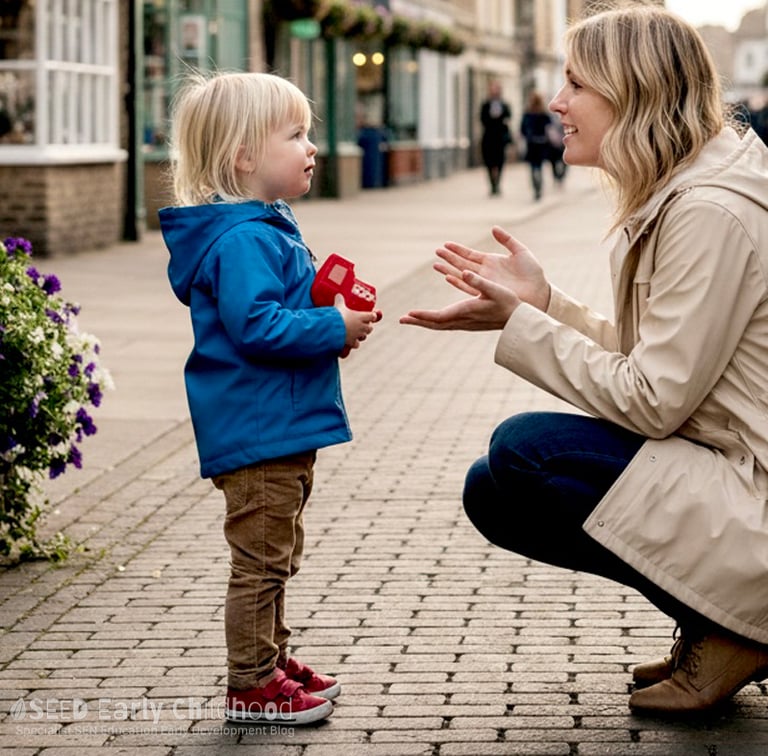
Image credit: AI. Mother explains consequences to toddler.
Using Consequences for Challenging Behaviour
Communicating boundaries and clear consequences for a toddler can support them to make better choices about their expression and behaviour. Example of calm communication consequence:
Explain the dangers to themselves or others
“Last time you fell down, and you were so sad.’’
Remind them of the feeling they had last time they made that choice
“You were so hungry last time, do you remember?”
Express that you understand their emotion
“I understand you’re angry. I would feel sad too.”
Allow chances for change
“When you use your indoor voice, you can play with us again”
Offer space
“Do you need some space? Why don’t you have a rest on the cushions?”
Being consistent with an approach can help the child to recognise what is expected. [1][4]
Positive reinforcement
Different from a bribe, positive reinforcement is given after the positive behaviour and not offered before. When a child receives positive attention for a positive behaviour, it can cause an association and repeat the actions. Acknowledging and rewarding desired behaviours can be verbal, small tokens such as stickers or an extra responsibility. [6][4]
References
1 The Royal Children’s Hospital (2025) Melbourne Challenging behaviour – toddlers and young children https://www.rch.org.au/kidsinfo/fact_sheets/Challenging_behaviour_toddlers_and_young_children/
2 Children first (2026) Challenging or distressed behaviour
https://www.childrenfirst.org.uk/get-support/advice-for-families/guidance-advice/articles/challenging-or-distressed-behaviour/
3 The Royal Wolverhampton NHS Trust Understanding_and_managing_your_childs_challenging_behaviour.pdf https://www.royalwolverhampton.nhs.uk/wp-content/uploads/2025/10/Understanding_and_managing_your_childs_challenging_behaviour.pdf
4 Action for children (2026) Challenging child behaviour, understand and manage behaviour https://parents.actionforchildren.org.uk/feelings-behaviour/understanding-emotions-behaviour/understanding-and-managing-my-childs-behaviour/
5 Challenging Behaviour Training (2025) https://www.highspeedtraining.co.uk/courses/safeguarding/challenging-behaviour-training/?_gl=1*1i5exni*_up*MQ..*_ga*MjAyOTQ1NDk3Mi4xNzcxNTc3MjY0*_ga_V4Y9K08SZ6*czE3NzE1NzcyNjMkbzEkZzAkdDE3NzE1NzcyNjMkajYwJGwwJGgxMTk5NzcyNzU5
6 Young Sprouts Therapy (2025) Top 10 Proven Techniques for Managing Challenging Behaviour in Children https://www.youngsproutstherapy.com/blog/top-10-proven-techniques-for-managing-challenging-behaviour-in-children
7 N/A
8 Donnelly, S. (2026) Special Educational Learning (SEL) https://seedearlychildhood.com/social-emotional-learning-sel
Author: SEED Early Childhood
SEED Early Childhood is an independent educational blog created with this mission: to provide free, professional insights into child development and education for parents.
Reviewed by:
SEED Early Childhood is the Educational blog founded by Samantha Donnelly to bring professionals to you.
Share this post
SEED Early Childhood Educational Blog
© 2026 SEED Early Childhood. All rights reserved. SEED Early Childhood is an Education Blog. Your use of this site is governed by our Terms and Conditions and Privacy Policy. Our website, blog services, content, and products are for informational purposes only. SEED Early Childhood does not provide medical advice, diagnosis, or treatment. See additional information.
Stay updated, subscribe to the newsletter.
SEED Early Childhood Guest Contributors
Educational Topics
Social Channels
Follow SEED Early Childhood on Social Media