
Early Intensive Behavioural Intervention (EIBI) Autism Treatment
SEED Early Childhood
SEED Early Childhood Educational Blog
Image credit: AI Thumbnail Autism Treatment EIBI Early Intensive Behavioural Intervention
Deep dive into autistic spectrum disorder, treatment,s and a focus on Early Intensive Behavioural Interventions (EIBI) and delivery.
Keywords: Autism EIBI Autistic Spectrum Disorder Children Autism Treatment
Author SEED Early Childhood
Reviewed by
5 February 2026




Credit AI. Mother engaging in PMT with a processional
According to a recent study [1], autism spectrum disorder (ASD) is on the rise, revealing that in the last twenty years, there has been a significant increase in the number of cases. Autism has a broad range of signs and symptoms, but is not categorised as an illness. Autism is a neurodevelopmental disorder.


Credit AI. A toddler has a 1:1 autism intervention
The Spectrum
The word ‘spectrum’ in autism spectrum disorder refers to the varying symptoms and levels of severity. However, the idea of the spectrum is criticised as being too broad. Two people with autism can be extremely different, and no person with autism has the exact same needs. For example, Asperger’s was a diagnosis given to those with higher functioning autism; this is no longer the case, and all diagnoses of autism, regardless of learning difficulty, are under one umbrella. [2][3]


Credit AI. A small child is supported by an early years professional
Early Years
The UK Early Years Foundation Stage (EYFS) is a statutory framework used in early years education. The EYFS specifies seven areas of development, physical, social emotional and communication and language, called Prime areas. These three areas are foundational to a child’s development of the four remaining Specific areas: literacy, mathematics, understanding the world and creative art and design.
Autism has a number of early communicative and social signs. Social skills and communication are two areas in which children with autism can struggle the most. Early intervention is so important in supporting a child’s future development. Practitioners and parents need to be equipped to address and act upon the developmental struggles of a child, as this can significantly improve their outcomes in their setting and for their future. [4][5][6]


Early Intensive Behavioural Interventions (EIBI)
EIBI is an evidence-based intervention which uses principles from Applied Behaviour Analysis (ABA) to teach adaptive behaviours to pre-school-aged children with autism.
Research has shown [6] that intensive, early treatment can make a notable impact on the lives of many children. Early intervention in the early years sector is a common term because it is widely accepted that early action is more effective. Identifying and addressing a child and family's needs early on can increase factors that positively influence a child’s wellbeing and reduce the negative risk. [7][2][9]
There is a lot of evidence to support the claims that EIBI is an effective treatment for autism with successful outcomes.
Credit: AI. A boy having a autism intervention with a therapist
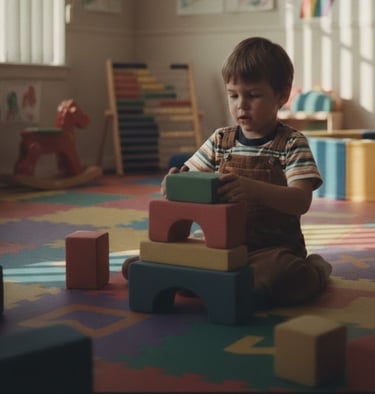

Image Credit: AI. Vintage style photo of early intervention research
What is Applied behaviour analysis (ABA) and Early intensive behavioural intervention (EIBI)?
In 1987, Dr Ole Ivar Loovas pioneered early ABA and EIBI interventions for autism. His study [1] from 1987 found that 47% of children undertaking ABA reached normal IQ levels, adaptive skills and social skills. Loovas’ study was a benchmark and showed 90% of children showing significant improvement. Treatment was on a 1:1 basis and was shown to be successful. These results were also found by other studies that replicated the original research. [10][11][12]


Credit: AI. Three children with autism sat engaging during an intervention
Applied behaviour analysis (ABA)
Applied behaviour analysis (ABA) is a research-based behaviour therapy for children with developmental disorders such as autism. The goal of ABA is to increase positive behaviours. Children can also develop skills through ABA. Comprehensive ABA-based interventions like EIBI have a theoretical foundation and usually start when the child is between 3 and 4 years old. Usually, the interventions are intensive, personalised and cover multiple skills. ABA uses many different techniques, such as rewards, visual aids, prompts, and negative reinforcement, with therapeutic techniques. Foundational to this is the ABC: antecedents, behaviour, and consequences. Comprehensive ABA-based methods like EIBI can also be used to target specific behaviours like toileting. [13][14][15]


Credit AI. Therapist and child during an autism intervention
Early intensive behavioural intervention (EIBI)?
Early intensive behavioural intervention (EIBI) was developed for the practices of ABA. EIBI is based on the learning theory of Behaviourism. Behaviourist theory says that learning comes through connecting stimuli and responses. Behaviourism explains that knowledge is gained through reward and negative experience. EIBI provides individual programs and is developed based on the child’s behaviour, communication and social skills, which is why EIBI is described as a personalised and structured approach. EIBI intervention can be given over several years at 20-40 hours per week and works to promote behavioural changes, using principles of ABA to increase positive behaviours and decrease behaviours such as aggression and self-harm. This method has been effective for children with autism as it focuses on the core difficulties. [16][17][18][19]
EIBI is standardly available in medical institutions, community settings (such as schools) and clinics in the USA, Australia, Canada, the Netherlands, Italy and Norway. In Norway, EIBI is usually publicly funded. Children with autism are usually given a place in a mainstream pre-school, and intervention is delivered by public, taxpayer-funded agencies. EIBI is not currently offered through the NHS and is only available in the UK privately. A study revealed [22] that it was decided that the cost of EIBI outweighed the benefits and did not meet the cost-effective thresholds laid out by NICE. However, the government is carrying out research into clinical trials for cost-effective interventions.[4][22][23]


Credit AI. 12 and 48 months olds engaging in ESDM
What are the other treatments for autism?
In addition to ABA and EIBI, there are lots of other early intervention models available for children with autism. From the research and studies on autism treatments, here are some of the key interventions: [25]
The Early Start Denver Model (ESDM)
The Early Start Denver Model (ESDM) is a diverse, early intervention approach designed by Dr Sally Rogers and Dr Geraldine Dawson. ESDM is for children with autism between 12 and 48 months old (1-2 years old). It is focused on building early social skills, interaction and motivation through active experimental learning. Groups are usually made up of three to four children and a therapist, although this approach can be given 1:1. ESDM incorporates ABA and is based on the principles of developmental science. A trained therapist assesses the child to identify their individual learning needs linked with developmental areas to provide naturalistic play-based routines. Like the delivery of the Early Years Foundation Stage (EYFS), as ESDM is a mixture of adult and child-led, although NDBI can vary.
The positive results from several studies support the work of ESDM as a promising intervention for young children with or at risk of an autism diagnosis. Regardless of whether received in a 1:1 or in a community-based group intervention, children had significantly improved in cognitive functioning by school age. [5][20][26][27][24][28][25]
Naturalistic Developmental Behavioural Interventions (NDBI)
Naturalistic Developmental Behavioural Interventions (NDBI) are a combination of ABA and developmental sciences, combining both behavioural and developmental theoretical and scientific principles and practices. Focusing on developmental practice, NDBI view some challenging behaviours in relation to the child’s age and stage of development, for example, toddlers having tantrums. Applying this method has shown to be successful at helping children regulate their behaviours. Lots of NDBI for young children with autism have been independently developed and validated. [29][30][40]


Credit AI. A group of children with autism in a group intervention with therapists
Discrete Trial Training (DTT)
Discrete Trial Training (DTT) is a behavioural intervention approach used in the 1987 Lovaas study. DTT has become increasingly popular. Like ABA, DTT uses rewards for desired behaviours, and learning is simplified and taught step-by-step for desired responses. Which is different from ABA, where undesirable behaviours are ignored. DTT has been studied in a UK mainstream school with good outcomes. [31]


Credit: AI. Mother has PMT with a professional
Parent-Mediated Therapy (PMT)
Parent-Mediated Therapy (PMT) is where a parent has training from a professional to gain techniques to deliver a specific therapy for their child. [32][33]
Positive Behaviour Support (PBS)
The NHS endorses the National Autistic Society for those seeking further advice about autism. The National Autistic Society have strong views against EIBI, although they seem to be more open to ABA. They raise an issue with EIBI’s former use of adversaries. However, contextually, in the time period that adversaries, when corporal punishment was being administered in the UK’s independent schools, which ended in 1998. The National autistic society promote Positive Behaviour Support (PBS). PBS is used for children with disabilities, and not specifically for autism. [33][38]
EIBI delivery
In a 1:1 session, the professional or parent works directly with the child in a clinic or in their home; this could potentially be done 1:1 in a school setting. Whereas in a community setting like as a classroom, other children are present, and the parents may also be present with the professional. Currently, EIBI begins with 1:1 delivery in a highly structured environment for about 25 + hours per week. Later, the delivery can be changed to a community group setting. Although this is quite different to the original Lovaas delivery, which was an institutional delivery, but later incorporated with parent participation.
A report by [24] showed children receiving both 15–20 hours of group therapy and 1 hour of 1:1 intervention per week for approximately 10 months. Which challenges the idea that children only benefit from one or the other. This extends on recent research suggesting that, on average, children benefit from EIBI, delivered in 1:1 or in community settings. [8][25] [34][35][20][24]


Credit: AI. Early years provision Norway.
EIBI delivery in Norway and Australia
In Norway and Australia, EIBI is available in the preschool classroom. Practitioners create inclusive classrooms; treatment is embedded into day-to-day learning, and parents are also supported beyond a 1:1 context to provide EIBI in the home. Unlike special educational settings, inclusive classrooms offer children with autism the opportunity to practice their developing skills with their typically developing peers, providing rich and age-appropriate social and communication opportunities. [35]
Private providers
Providers of private EIBI treatment in the UK often offer training courses for practitioners. [35]


Credit AI. Artistic illustration of Aristotle
Ethics, Flourishing and Philosophy
There is the belief that children with autism are enabled to flourish as a result of EIBI. Educational flourishing can be seen as an ethical issue. Research [11] findings questioned whether, after intervention, children would only model behaviours but not feel them appropriately. Research by [12] says that ABA intervention for children with autism has a good chance at producing intelligent, social children, which is a requirement for Aristotelian flourishing. Aristotle suggests that we should consider the “function (ἔργον) of a human being”. [37][36]
Summary
EIBI is one of the most widely used treatments for children with autism. Historically, the delivery of EIBI would have been 1:1 as it was an institutionalised intervention. ABA and EIBI have taken a significant leap since the 1960’s from institutional-based therapy to mixed delivery, parent participation and inclusive pre-school classrooms.
Now, community-based interventions and 1:1 delivery can be delivered interchangeably.
Usually beginning with the 1:1 approach and transitioning into a community setting. Both types of delivery have shown to have equal outcomes. EIBI is offered in medical settings and preschools in Norway, Canada, Australia, Italy, the Netherlands and the USA. Although knowledge about EIBI is global, EIBI is not available on the NHS due to the cost; ABA, on the other hand, may be accessed through referral, but EIBI treatment is available in the UK through private provisions. [34][20][35]
In addition to EIBI, there are many treatments available for preschool-aged children with autism. Information on EIBI in the UK is limited, and organisations like the National autism society are not in favour of EIBI. They offer Positive behaviour support (PBS), which is a generalised intervention nonspecific to autism. Even with EIBI’s well-researched evidence and data first documented by Lovaas in 1987, there is little awareness in the UK outside of the private clinics and academic papers. Informal conversations with parents and even with seasoned practitioners revealed a general lack of awareness regarding ABA practice and no knowledge of EIBI. [4][10][30]
This post was originally an appreciative enquiry (AE) into autism treatment and effective delivery, specifically looking at EIBI. As a topic of professional interest. This enquiry objective was to raise awareness, improve outcomes and support parents.
References
1 Wang, C. and Wang, H. (2024) ‘The growing challenge of autism spectrum disorder: a comprehensive review of etiology, diagnosis, and therapy in children’, All Life, 17(1). Available at: doi:10.1080/26895293.2024.2415057
2 MFMER (2024) Autism Spectrum Disorder. Available at: https://www.mayoclinic.org/diseasesconditions/autism-spectrum-disorder/symptoms-causes/syc-20352928
3 The National Autism Society (2024) Asperger syndrome (Asperger’s). Available at: https://www.autism.org.uk/advice-and-guidance/what-is-autism/the-history-of-autism/aspergersyndrome
4 Department for education (2024) Early years foundation stage statutory framework For group and school-based providers. Available at: https://assets.publishing.service.gov.uk/media/670fa42a30536cb92748328f/EYFS_statutory_framework
forgroup_and_school_-_based_providers.pdf
5 Lord, C., Elsabbagh, M., Baird, G and Veenstra-Vanderweele, J. (2018). ‘Autism spectrum disorder’,
Lancet (London, England), 392(10146), pp. 508–520. Available at: https://doi.org/10.1016/S01406736(18)31129-2
6 NHS (2022) What is autism? Available at: https://www.nhs.uk/conditions/autism/what-is-autism/
7 NSPCC (2024) Early help and early intervention. Available at: https://learning.nspcc.org.uk/safeguardingchild-protection/early-help-and-early-intervention
7 Klintwall, L. and Eikeseth, S. (2014) ‘Early and Intensive Behavioral Intervention (EIBI) in Autism’. Available at: DOI 10.1007/978-1-4614-4788-
8 Suppo, L. (2017) The History of Behavioral Treatments in Autism: From the Punitive to the Positive.
Available at: https://files.eric.ed.gov/fulltext/EJ1164503.pdf
9 NSPCC (2024) Early help and early intervention. Available at: https://learning.nspcc.org.uk/safeguardingchild-protection/early-help-and-early-intervention
10 Lovaas, O. (1987) ‘Behavioral Treatment and Normal Educational and Intellectual Functioning in Young Autistic Children’, Journal of consulting and clinical psychology, 55(1), pp. 3–9. Available at: https://doi.org/10.1037/0022-006X.55.1.3
11 Potter, N. (2015)‘Doing Right and Being Good: What It Would Take for People Living with Autism to Flourish’, Philosophy, Psychiatry, & Psychology, 22 (4), pp. 263-265. Available at: https://dx.doi.org/10.1353/ppp.2015.0055
12 Furman, T. and Tuminello, A. (2015) ‘Aristotle, Autism, and Applied Behavior Analysis. Philosophy, Psychiatry, & Psychology’, 22 pp. 253-262. Available at: doi:10.1353/ppp.2015.0052.
13 Cleveland clinic (2024) Applied Behavior Analysis (ABA). Available at:
https://my.clevelandclinic.org/health/treatments/25197-applied-behavior-analysis
14 Eckes, T., Buhlmann, U., Holling, D. and Möllmann, A. (2023) ‘Comprehensive ABA-based interventions in the treatment of children with autism spectrum disorder – a meta-analysis’, BMC psychiatry, 23(1), pp. 133–19. Available at: https://doi.org/10.1186/s12888-022-04412-1
15 GSEP (2023) ABA Techniques: Strategies for Behavior Analysts. Available at: https://gsep.pepperdine.edu/blog/posts/aba-techniques-strategies-for-behavior-analysts.htm
16 Gandhi, H. and Mukherji, P. (2023) Learning Theories. Available at: https://www.ncbi.nlm.nih.gov/books/NBK562189/
17 Reichow, B., Barton, E., Boyd, A., Hume, K., Macdonald, G. and Wilson, J. (2014) ‘Early Intensive
Behavioral Intervention (EIBI) for Young Children with Autism Spectrum Disorders (ASD): A Systematic Review’, Campbell systematic review, 10(1), pp. 1–116. Available at: https://doi.org/10.4073/csr.2014.9
18 Aspire Intervention (2024) The Top Benefits of EIBI: How Can EIBI Benefit Autism? Available at: https://aspireearlyintervention.com/blog/the-top-benefits-of-eibi-how-can-eibi-benefit-autism/
19 Stages learning (2016) A Closer Look: Early Intensive Behavioral Intervention (EIBI) Available at:
https://blog.stageslearning.com/blog/early-intensive-behavioral-intervention-eibi
20 Rogers, J., Yoder, P., Estes, A,, Warren, Z., McEachin, J., Munson, J., Rocha, M., Greenson, J., Wallace, L., Gardner, E., Dawson, G., Sugar, A., Hellemann, G. and Whelan, F. (2021) ‘A Multisite Randomized
Controlled Trial Comparing the Effects of Intervention Intensity and Intervention Style on Outcomes for Young Children With Autism’ J Am Acad Child Adolesc Psychiatry. 60(6), pp. 710-722. Available at: https://doi.org/10.1016/j.jaac.2020.06.013
22 McCandless, S. and Hoerger, M. (2022). ‘Cost‐effective models for delivering behaviour analysis teaching in UK schools and local authorities. British Journal of Special Education. 49(2), pp. 261-275 Available at: https://doi.org/10.1111/1467-8578.12399
23 Eldevik, S., Titlestad, B., Aarlie, H. and Tønnesen, R. (2019) ‘Community Implementation of Early
Behavioral Intervention: Higher Intensity Gives Better Outcome’, European Journal of Behavior Analysis, 21(1), pp. 92–109. Available at: https://doi.org/10.1080/15021149.2019.1629781
24 Waddington, H., van der Meer, L. and Sigafoos, J. (2017), ‘Effectiveness of the Early Start Denver Model: a Systematic Review’, Review Journal of Autism and Developmental Disorders, vol. 3,(2). pp. 93-106. Available at: https://doi.org/10.1007/s40489-015-0068-3
25 Vinen, Z., Clark, M., Paynter, J. and Dissanayake, C. (2018) ‘School Age Outcomes of Children with Autism Spectrum Disorder Who Received Community-Based Early Interventions’, Journal of autism and developmental disorders. 48(5), pp. 1673–1683. Available at: https://doi.org/10.1007/s10803-017-34148
26 Cucinotta, F., Vetri, L., Ruta, L., Turriziani, L., Benedetto, L., Ingrassia, M., Maggio, R., Germanò, E.,
Alquino, A., Siracusano, R., Roccella, M. and Gagliano, A. (2022) ‘Impact of Three Kinds of Early
Interventions on Developmental Profile in Toddlers with Autism Spectrum Disorder’, Journal of Clinical
Medicine, 11(18), pp. 5424. Available at: https://doi.org/10.3390/jcm11185424
27 Duke Center for Autism and Brain Development (2024) Early Start Denver Model (ESDM). Available at: https://autismcenter.duke.edu/education-training/early-start-denver-model-esdm-training
28 Dawson, G., Rogers, S., Munson, J., Smith, M., Winter, J., Greenson, J., Donaldson, A. and Varley, J. (2010) ‘Randomized, controlled trial of an intervention for toddlers with autism: the Early Start Denver Model’, Pediatrics, 125(1) pp. 17-23. Available at: doi:10.1542/peds.2009-0958.
29 Sage Learning Systems (2023) What are Naturalistic Developmental Behavioral Interventions (NDBIs)?.Available at: https://www.sagelearningsystems.com/post/what-are-naturalisticdevelopmental-behavioral-interventions-ndbis
30 Schreibman, L., Dawson, G., Stahmer, A. C., Landa, R., Rogers, S. J., McGee, G. G., Kasari, C., Ingersoll, B., Kaiser, A. P., Bruinsma, Y., McNerney, E., Wetherby, A. and Halladay, A. (2015) ‘Naturalistic Developmental Behavioral Interventions: Empirically Validated Treatments for Autism Spectrum Disorder’, Journal of autism and developmental disorders, 45(8), pp. 2411–2428. Available at:
https://doi.org/10.1007/s10803-015-2407-8
31. CDC, (2024) Treatment and Intervention for Autism Spectrum Disorder (ASD). Available at:
https://www.cdc.gov/autism/treatment/index.html#:~:text=to%20the%20situation.-,Complementary%2 0and%20alternative%20treatments,-Some%20people%20with
32. NICHD (2017) Parent-Mediated Therapy in Autism | - Eunice Kennedy Shriver National Institute of Child Health and Human Development. Available at:
https://www.nichd.nih.gov/health/topics/autism/conditioninfo/treatments/parent-mediated
33. The National Autism Society (2024) Positive Behaviour Support. Available at:
https://www.autism.org.uk/advice-and-guidance/topics/positive-behaviour-support-pbs
34 Reichow, B., Hume, K., Barton, E., Boyd, A. and Reichow, B. (2018) ‘Early intensive behavioral intervention (EIBI) for young children with autism spectrum disorders (ASD)’, (10), pp. CD009260. Available at: https://doi.org/10.1002/14651858.CD009260.pub3
35Vivanti, G. Dissanayake, C. Duncan, E. Feary, J. Capes, K. Upson, S. Bent, C. A. Rogers, J. Hudry, K. Jones, C. Bajwa, H. Marshall, A. Maya, J. Pye, K. Reynolds, J. Rodset, D. and Toscano, G. (2019) ‘Outcomes of children receiving Group-Early Start Denver Model in an inclusive versus autism-specific setting: A pilot randomized controlled trial’, Autism, 23(5), pp. 1165-1175. Available at: https://doi.org/10.1177/1362361318801341
36 Symons, X. and VanderWeele, T. (2024) ‘Aristotelian Flourishing and Contemporary Philosophical Theories of Wellbeing’, J Happiness Stud, 25(26). Available at: https://doi.org/10.1007/s10902-02400723-0
37 Furman, T. and Tuminello, A. (2015) ‘Aristotle, Autism, and Applied Behavior Analysis. Philosophy, Psychiatry, & Psychology’, 22 pp. 253-262. Available at: doi:10.1353/ppp.2015.0052.
38 BBC, (1998), Corporal punishment banned for all. Available at: http://news.bbc.co.uk/1/hi/uk/politics/69478.stm
Author: SEED Early Childhood
Reviewed by:
SEED Early Childhood is the Educational blog founded by Samantha Donnelly to bring professionals to you.
Share this post
SEED Early Childhood Educational Blog
© 2026 SEED Early Childhood. All rights reserved. SEED Early Childhood is an Education Blog. Your use of this site is governed by our Terms and Conditions and Privacy Policy. Our website, blog services, content, and products are for informational purposes only. SEED Early Childhood does not provide medical advice, diagnosis, or treatment. See additional information.
Stay updated, subscribe to the newsletter.
SEED Early Childhood Guest Contributors
Educational Topics
Social Channels
Follow SEED Early Childhood on Social Media
Special Educational Need (SEN)
© 2026 SEED Early Childhood Samantha Donnelly BA (Hons), MA (Sole Trader) (T/A) SEED Early Childhood 204 Milne Building, Heritage Lane, NW6 2AF
© 2026 SEED Early Childhood Samantha Donnelly BA (Hons), MA (Sole Trader) (T/A) SEED Early Childhood 204 Milne Building, Heritage Lane, NW6 2AF samantha@seedearlychildhood.com
© 2026 SEED Early Childhood. All rights reserved. SEED Early Childhood is an Education Blog. Your use of this site is governed by our Terms and Conditions and Privacy Policy. Our website, blog services, content, and products are for informational purposes only. SEED Early Childhood does not provide medical advice, diagnosis, or treatment. See additional information.