
Cultural Capital
SEED Early Childhood Educational Blog
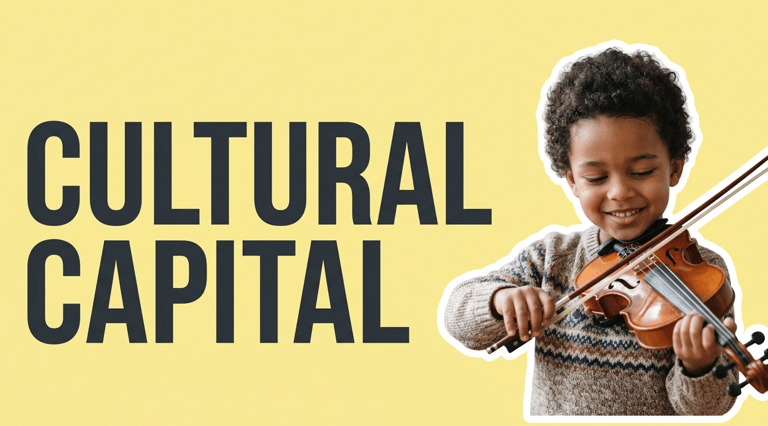
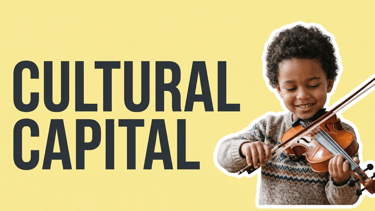
A look at cultural capital, an interesting social concept that could help improve children's education.
Keywords: Cultural Capital Philosophy Academic Excellence School Success Cultural Experiences
Author Samantha Donnelly
31 March 2026
Cultural capital is one of the concepts of the sociological researcher Pierre Bourdieu, in 1986 found in his book The Forms of Capital. [1]


Image credit: AI. Philosophical and historical books and art.
What is ‘Culture’?
Culture in the English language can mean different things. According to the Cambridge dictionary, one of the many definitions of culture refers to:
‘‘Music, art, theatre, literature, etc’’
According to the Collins dictionary, one of the definitions is:
“Culture consists of activities such as the arts and philosophy, which are considered to be important for the development of civilisation and of people's minds.” [2][3]
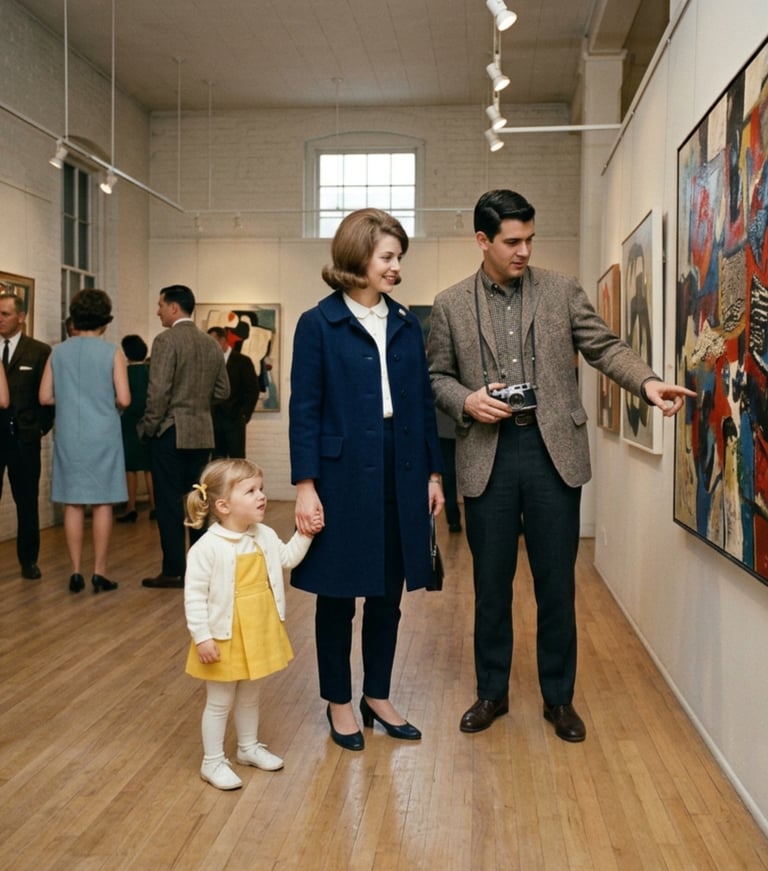
Image credit: AI. Parents in the 60's taking their toddler to an art gallery.
What is Cultural Capital?
Cultural Capital is a complex theory from the field of sociology. Cultural capital views culture as an investment that gives advantages connected with social position. This idea was developed by Pierre Bourdieu in 1960. During his investigations, Bourdieu saw families passing on cultural capital to their children, introducing them to dance and music, taking them to historic sites, galleries, theatres and talking about art and literature over dinner.
Bourdieu found three sources of cultural capital:
Objective: Cultural goods, books, works of art
Embodied: Language, mannerisms, preferences
Institutionalised: Qualifications, education credentials [4][6][10][12]
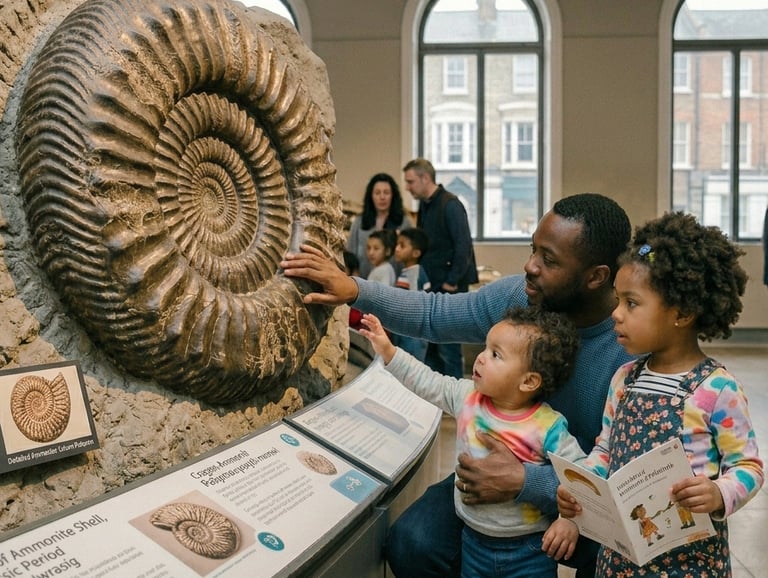
Image credit: AI. Father at the museum with his children.
What Can Parents Do?
From a child’s earliest stages, they will be learning and gaining cultural capital. When a child is growing up, their parents are seen as their first ‘teachers’, and their family is the educational ‘institution’.
According to the principles of cultural capital, opportunities for cultural capital:
Encouraging politeness
Encouraging good manners
Encouraging a good presentation
Having cultural conversations
Listening to music, specifically Classical styles
Having art or artefacts at home
Reading and discussing books
Reading poems together
Visiting museums
Visiting the library
Visiting art galleries
Visiting historical sites
Going to the theatre
Travelling to different countries
Extracurricular activities, such as learning an instrument or dance
Extra educational tuition
The knowledge children gain through cultural capital gets larger over time as they are exposed to more cultural experiences and encounters. [5][8][9][10]
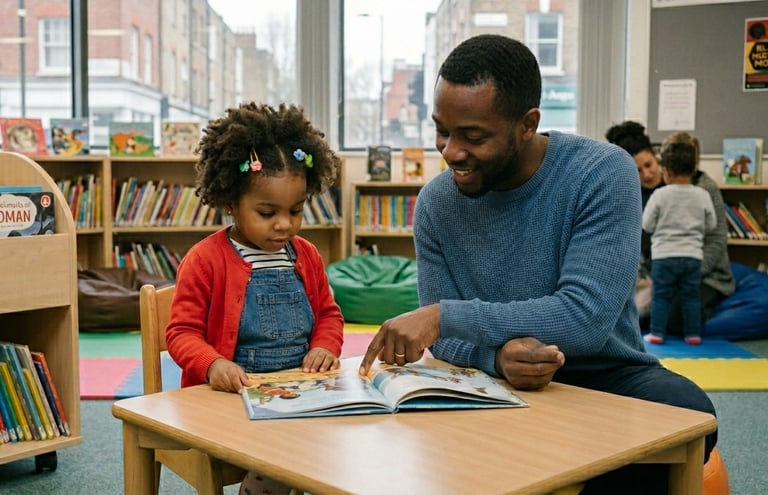
Image credit: AI. Child at the library with her dad.
Is there Proof?
Evidence suggests that the cultural capital passed on through families helps children do better in school. It is believed to contribute to social status and the ability to do well academically. The Sutton Trust study found that parents investing in extracurricular activities and tuition from high socioeconomic groups did so to prevent their children from falling behind. While the Sutton Trust research reflects cultural capital with financial investment, Bourdieu’s investigations considered cultural academic achievement through cultural capital beyond economic status. [4][6][10][11]
Cultural Capital in Nursery and School
Children bring the cultural capital they have gained from their parents into the educational setting. When children join an early years (0-5 years) educational environment, they gain opportunities to explore experiences through the curriculum. In early years education, the statutory document, the EYFS, directs the delivery by both childminders and group or school-based providers. The unique child is one of the overarching principles of the EYFS: ‘Every child is a unique child, who is constantly learning and can be resilient, capable, confident, and self-assured.’ This can be understood as reflecting a child’s cultural capital. [4][7][8]
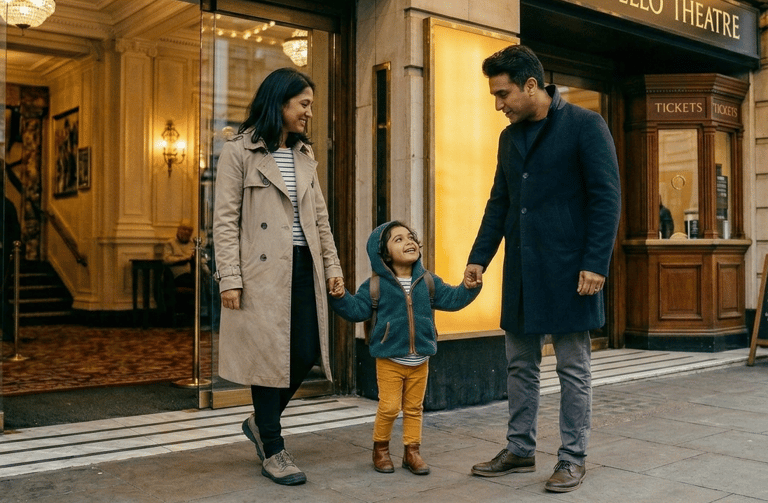
Image credit: AI. Parents take their child to the theatre.
Summary
Cultural capital is a complex concept where children are understood to gain better social and academic outcomes through the cultural exposure they receive; first at home with their parents and in their family, and secondly at nursery or school, through practices such as good etiquette and artistic experiences. Evidence suggests cultural capital can have positive effects on a child’s educational outcomes.
Author: Samantha Donnelly BA (Hons) MA
Samantha Donnelly is an Early Childhood Practitioner with more than 15 years of experience working with children, specialising in Early Childhood Education. Samantha is the founder of SEED Early Childhood Educational Blog.
SEED Early Childhood is an independent educational blog created with this mission: to provide free, professional insights into child development and education for parents.
SEED Early Childhood is the Educational blog founded by Samantha Donnelly to bring professionals to you.
References
1 Ebrary Cultural capital, Definition of cultural capital https://ebrary.net/214894/sociology/cultural_capital
2 Cambridge Dictionary (2026) CULTURE https://dictionary.cambridge.org/dictionary/english/culture
3 Collins Dictionaries (2026) CULTURE definition and meaning https://www.collinsdictionary.com/dictionary/english/culture
4 Silva E., Cultural Capital https://oro.open.ac.uk/56776/1/__hulse_es244_papers_cultural capital - Encyclopedia Wiley.pdf
5 Xiaowei, Huang. (2019) Understanding Bourdieu - Cultural Capital and Habitus. Review of European Studies. 11. Pp. 45-45. http://doi.org/10.5539/res.v11n3p45
6 Cultural capital (2021) Early Education https://early-education.org.uk/cultural-capital/
7 Department for Education (2025) EYFS statutory framework for group and school-based providers https://assets.publishing.service.gov.uk/media/68c024cb8c6d992f23edd79c/Early_years_foundation_stage_statutory_framework_-_for_group_and_school-based_providers.pdf.pdf
8 Smith, R. (2025) Top tips: Cultural Capital in early years https://ndna.org.uk/blog/cultural-capital-in-early-years/
9 Rose, J. (2024) What is cultural capital in the EYFS? https://www.famly.co/blog/what-is-cultural-capital-in-the-early-years
10 Cultural Learning Alliance (2019) What is cultural capital? https://www.culturallearningalliance.org.uk/what-is-cultural-capital/
11 The Sutton Trust Parent Power (2018) https://www.suttontrust.com/our-research/parent-power-2018-schools/
12 Nottingham Education Explain: Cultural Capital –Network https://nottinghameducationnetwork.co.uk/nen-explain/nen-explain-cultural-capital/
Share this post
Support SEED Early Childhood
Keep reading
Learn more about Autism, Early Development and Early Education
SEED Early Childhood Educational Blog
© 2026 SEED Early Childhood. All rights reserved. SEED Early Childhood is an Education Blog. Your use of this site is governed by our Terms and Conditions and Privacy Policy. Our website, blog services, content, and products are for informational purposes only. SEED Early Childhood does not provide medical advice, diagnosis, or treatment. See additional information.
Stay updated, subscribe to the newsletter.
SEED Early Childhood Guest Contributors
Educational Topics
Social Channels
Follow SEED Early Childhood on Social Media