
ADHD Q&A
SEED Early Childhood Educational Blog
What is ADHD? What are the signs? Learn more about ADHD through this Q&A post.
Keywords— ADHD ADHD Questions ADHD FAQ ADHD what is it? Attention deficit hyperactivity disorder (ADHD)
Author SEED Early Childhood
DATE 15 April 2026
What is ADHD?
Attention Deficit Hyperactivity Disorder (ADHD) is a neurological, neurodevelopmental disorder that develops in early childhood, characterised by lack of attention and impulsivity. It is one of the most common neurological disorders, with approximately 4 in 100 individuals having the condition. [1][6][11][12]
How does ADHD affect the brain?
ADHD is a neurodevelopmental condition as it affects brain development. This means a child with ADHD will have differences in their brain development and function compared to neurotypical children. This difference is described as neurodivergence. ADHD can affect different parts of the brain which control abilities called executive function, which can impair memory, thinking patterns, social skills and learning. [1][11][13]
Are there different kinds of ADHD?
There are three subtypes of ADHD:
Hyperactive-impulsive
The child may appear nervous and restless, always seeming to be ‘on the go’. They may struggle to sit quietly for long periods and fidget when they do. Excessive talking and interrupting others’ conversations or games are common, along with difficulty waiting for their turn. They may also show immaturity and fail to respect physical boundaries, displaying destructive behaviours. Hyperactivity-impulsivity is the primary symptom of ADHD in many pre-school-age children.
Inattentive
The child may be easily distracted and also daydream, showing imagination. They may struggle to pay attention to detail or make silly mistakes when working or playing; they may not finish tasks and may find it difficult to maintain attention for long periods. They may be forgetful and disorganised, often losing their belongings. Inattention is common symptom in children aged 5 to 9 years.
Combined
A child who experiences symptoms from both the inattention and hyperactivity-impulsivity categories. The combined category is the most common type of ADHD. [2][6][8][10][21]
Do genetics play a role in ADHD?
The exact cause of ADHD remains unknown, but there are risk factors which might contribute to or increase the symptoms of ADHD. For some researchers, the genetic basis is foundational for the occurrence of ADHD. Research into twins has shown a 90% concordance with the condition. [1][6]
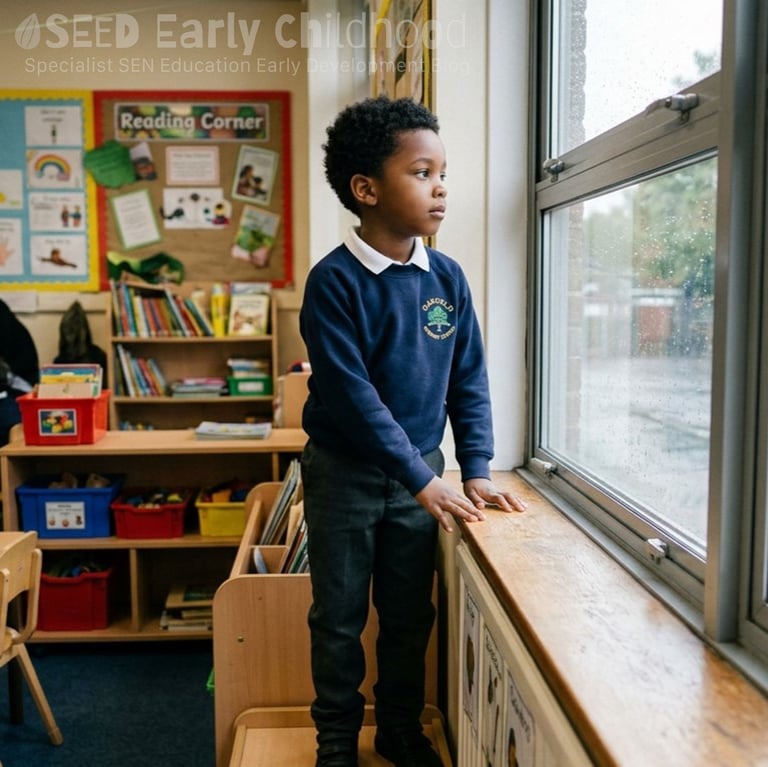

Image credit: AI. Boy with ADHD looks out of the window.
When are children usually identified with ADHD?
ADHD is an early-onset disorder, which means it begins in early childhood. However, approximately a third of children will show symptoms between the ages of 3 - 6 and 7-12-years-old. An ADHD diagnosis could be considered when the child is very young, but diagnosis usually happens when the child is around 6 years old, and they have entered school. Later diagnosis could be because a child’s challenges become evident in a school environment where they are required to pay attention and sit still. Some children have a much later diagnosis when they reach secondary school; in some cases, ADHD might be missed or misdiagnosed. [8][10][11][14]
What about diagnosis?
Before diagnosis, there must be identification. Boys are more frequently diagnosed with ADHD than girls. Some researchers believe this is down to an under-representation at the referral stage and a lack of identification during observations. For an initial identification of a child presenting ADHD symptoms (i.e by a parent or teacher), they could be observed alongside peers of a similar developmental age and stage. For example observing whether:
The child displays a shorter attention span
The child is distracted and almost absent, even when directly spoken to
The child is continuously restless even at mealtimes
The child is unable to wait in line or wait for their turn
The child is very excitable
The child is very impulsive
The child becomes locked into interests
The child engages in risky behaviour
The child has mood symptoms
The child is anxious
The child has sensory differences
Accurate identification of ADHD and implementation of effective interventions are essential. There are international standards for diagnosing ADHD. One or both of the following core symptoms must be present in multiple settings, i.e. at home and at school:
Inattention
hyperactivity
Impulsivity
Symptoms must be present before the age of 12 years and clearly interfere with the quality of social life and function. [6][7][8][9][10][12][14]
Male and Female ADHD: What are the common issues?
In males, workaholism can be a problem as work can provide high levels of stimulation but may also cause social isolation due to the nature of such behaviours. Males with ADHD can overcompensate with perfectionism to cope with impulse and ‘silly’ mistakes but can become exhausted doing this long-term. ADHD can be unrecognised in girls because they may have more inattentive symptoms than boys, which can go unnoticed. Girls may also mask their symptoms better. The impact of a missed diagnosis can be significant. Without appropriate treatment, children with ADHD have a risk of antisocial conduct, learning difficulties and emotional problems. [7][10][11][17][21]
What are the challenges of parenting a child or children with ADHD?
It is important to understand that the child’s behaviour may be beyond their control and unintentional. A child with ADHD may struggle with inconsistency, but for the child, this is normal, and the parent may need support to understand the condition and address the behaviour. Psychoeducation is a teaching program for parents to learn strategies for managing their child’s ADHD. [6][7][12][20][21]
What Other Conditions are Associated with ADHD?
About 60% to 80%of children with ADHD have another condition. Commonly associated conditions are:
Anxiety
Depression
Oppositional Defiant Disorder (ODD)
Autism Spectrum Disorder (ASD)
Epilepsy
Tic Disorders (TD).
Sleep Disorders
Learning Difficulties
Language Disorders
Dyslexia
Dyspraxia
[4][6][7][10][11]


Image credit: AI. School girl with ADHD blasting in a social situation.
What effects does ADHD have on social well-being?
Children with ADHD will usually struggle with social skills as a coping mechanism, children with ADHD may adopt aggressive, confrontational self-presentation called blasting. Blasting can negatively impact social interactions. Children with ADHD can often have a lower tolerance for frustration. Symptoms such as hyperactivity and impulsivity can lead to social rejection, which is also a difficult situation for children with ADHD to experience. Rejection-sensitive dysphoria (RSD), is a sense of not being enough and the idea of being excluded because of your difference or failings. RSD is a syndrome and is similar to social anxiety and imposter syndrome, which can be experienced by children with ADHD. Research exploring Health Related Quality of Life (HRQoL) found that neurotypical children ranked poorer than neurotypical children. This research highlights the importance of considering a child’s well-being, not only their ADHD, when providing support. Support for social skills and well-being can be delivered through therapy and Social Skills Training (SST). [3][6][7][19][21]
How does ADHD affect a child in Education?
It is normal for children to feel distracted and restless from time to time. For a child with ADHD, they may find this a daily challenge. While it is true that children with ADHD can be easily distracted and impulsive, they can also have intense attention called hyperfocus. Children with ADHD can enter hyperfocus when they are doing something interesting or intriguing. This can be a contributing factor as to why a child with ADHD can find their journey through education a difficult one. Children with ADHD may find they ‘get into trouble’ for their symptoms and are misunderstood. Their ability to learn can therefore be limited. While standard care can be delivered in a medical setting such as a clinic, educational settings can also support the child through understanding, interventions and adjustments. [10][11][12][18]


Image credit: AI. Young boy with ADHD riding a bike.
Can ADHD be treated?
Yes. ADHD is treatable, and this makes early intervention important. Medication and therapy are the first point of action when it comes to ADHD. There are many other therapeutic approaches and successful strategies that professionals can recommend. [2][5][6][7][8]
MEDICATION
There are two types of ADHD medications: stimulants and non-stimulants. Both types are understood to change the chemical balance of the brain. Like all medication stimulants and non-stimulants come with possible side effects. [12][21]
THERAPY
Cognitive-Behavioural Therapy (CBT) is strongly recommended for children with ADHD. CBT can provide a child with strategies to manage their symptoms, especially those connected to cognitive and behavioural functioning. [6][11][12][21]
SOCIAL SKILL TRAINING (SST)
Social Skills Training (SST) is an effective psychosocial intervention that focuses on social skills, listening skills, problem-solving, self-control, and the management and expression of emotions. [2][7][10] [21]
EXERCISE
There is evidence that exercise can reduce the symptoms of ADHD. Regular exercise is encouraged and has been found to specifically reduce hyperactivity-impulsivity and improve focus. [7][10][12][21]
DIET
Diet and supplementation therapies are used as a treatment for ADHD. Following specific diets, such as oligoantigenic or additive-free diets, can be recommended by professionals. [5][6][12][21]
NEUROFEEDBACK THERAPY
Neurofeedback, or EEG biofeedback, is a non-invasive therapy that helps the conscious control of brain waves. Research has shown that the therapy improves ADHD symptoms. [6][15][21]
PSYCHOEDUCATION
Psychoeducation is a teaching program delivered by a mental health professional for those diagnosed with ADHD, their parents and their teachers. The professional teaches on ADHD, symptoms, daily impact and management strategies. [6][7][12][21]
Summary
ADHD is a complex neurodevelopmental condition that affects a large number of children globally. Early intervention and support can enable the child to have the best start and a better quality of life.
Author: SEED Early Childhood
SEED Early Childhood is an independent educational blog created with this mission: to provide free, professional insights into child development and education for parents.
Reviewed by:
SEED Early Childhood is the Educational blog founded by Samantha Donnelly to bring professionals to you.


References
1 Driga, Anna Maria & Drigas, Athanasios. (2019). ADHD in the Early Years: Pre-Natal and Early Causes and Alternative Ways of Dealing. International Journal of Online Engineering (iJOE). 15. 95-102. 10.3991/ijoe.v15i13.11203.
2 Eiland, L. S., & Gildon, B. L. (2024). Diagnosis and Treatment of ADHD in the Pediatric Population. The Journal of Pediatric Pharmacology and Therapeutics : JPPT, 29(2), 107. https://doi.org/10.5863/1551-6776-29.2.107
3 Arachchige Dona, S. W., Badloe, N., Sciberras, E., Gold, L., Coghill, D., & D. Le, H. N. (2023). The Impact of Childhood Attention-Deficit/Hyperactivity Disorder (ADHD) on Children’s Health-Related Quality of Life: A Systematic Review and Meta-Analysis. Journal of Attention Disorders. https://doi.org/10.1177/10870547231155438
4 Approaches to Treating Children With ADHD and Common Comorbidities Lalonde, Molly A. et al. Journal of Pediatric Health Care, Volume 39, Issue 2, 318 – 325 Approaches to Treating Children With ADHD and Common Comorbidities - Journal of Pediatric Health Care
5 Bradley S. Peterson, Joey Trampush, Margaret Maglione, Maria Bolshakova, Mary Rozelle, Jeremy Miles, Sheila Pakdaman, Morah Brown, Sachi Yagyu, Aneesa Motala, Susanne Hempel; Treatments for ADHD in Children and Adolescents: A Systematic Review. Pediatrics April 2024; 153 (4): e2024065787. 10.1542/peds.2024-065787
6 Kumar, G., Sharma, B., Tiwari, R. K., Kumar, R., & Singh, M. K. (2024). A review on ADHD disorder, diagnosis and therapeutic approach in children and adolescents. Brain-Apparatus Communication: A Journal of Bacomics, 3(1). https://doi.org/10.1080/27706710.2024.2400070
7 Citation: Cinderella, M., and L. Akash Pramoth. “A Systematic Review on Effects and Impact of ADHD in Children.” Shanlax International Journal of Arts, Science and Humanities, vol. 12, no. S1, 2024, pp. 9–13. https://doi.org/10.34293/sijash.v12iS1
8 Hagan, F (2026) Attention deficit hyperactivity disorder in children - Symptoms, diagnosis and treatment https://bestpractice.bmj.com/topics/en-gb/142
9 NHS inform (2024) Attention deficit hyperactivity disorder (ADHD) https://www.nhsinform.scot/illnesses-and-conditions/mental-health/attention-deficit-hyperactivity-disorder-adhd/ - therapy
10 Great Ormond Street Hospital Attention deficit hyperactivity disorder (ADHD) https://www.gosh.nhs.uk/conditions-and-treatments/general-medical-conditions/attention-deficit-hyperactivity-disorder-adhd/
11Great Ormond Street Hospital for Children Attention deficit hyperactivity disorder (ADHD) https://www.gosh.nhs.uk/conditions-and-treatments/general-medical-conditions/attention-deficit-hyperactivity-disorder-adhd/
12 Bupa Attention deficit hyperactivity disorder (ADHD) Attention deficit hyperactivity disorder (ADHD): signs, diagnosis and support | Bupa UK
13 Stephens, R. L., Elsayed, H. E., Reznick, J. S., Crais, E. R., & Watson, L. R. (2021). Infant Attentional behaviors Are Associated With ADHD Symptomatology and Executive Function in Early Childhood. Journal of attention disorders, 25(13), 1908–1918. https://doi.org/10.1177/1087054720945019
14 Willoughby, M. T., Williams, J., Mills-Koonce, W. R., & Blair, C. B. (2020). Early Life Predictors of Attention Deficit/Hyperactivity Disorder Symptomatology Profiles from Early Through Middle Childhood. Development and Psychopathology, 32(3), 791. https://doi.org/10.1017/S0954579419001135
15 Marzbani, H., Marateb, H. R., & Mansourian, M. (2016). Neurofeedback: A Comprehensive Review on System Design, Methodology and Clinical Applications. Basic and Clinical Neuroscience, 7(2), 143. https://doi.org/10.15412/J.BCN.03070208
16 Birmingham Community Healthcare Trust ADHD: Frequently Asked Questions https://www.bhamcommunity.nhs.uk/ndp-adhd-faqs/
17 Oluvardia, R. Lesser Known Potential Signs of ADHD in Men? https://www.adhdawarenessmonth.org/signs-and-features-adhd-men/ -
18 ACO People with ADHD just can’t concentrate: MYTH! https://www.adhdawarenessmonth.org/concentration-myth/
19 Dr. Sharon Saline Why does rejection feel so intense for people with ADHD? https://www.adhdawarenessmonth.org/intense-reactions-to-rejection-adhd/
20 Torres, Dulce The challenges of parenting a child with ADHDhttps://www.adhdawarenessmonth.org/parenting-a-child-with-adhd/
21 SEED Early Childhood (2026) ADHD https://seedearlychildhood.com/adhd
Share this post
Keep reading
Learn more about Autism, Early Development and Early Education
SEED Early Childhood Educational Blog
© 2026 SEED Early Childhood. All rights reserved. SEED Early Childhood is an Education Blog. Your use of this site is governed by our Terms and Conditions and Privacy Policy. Our website, blog services, content, and products are for informational purposes only. SEED Early Childhood does not provide medical advice, diagnosis, or treatment. See additional information.
Stay updated, subscribe to the newsletter.
SEED Early Childhood Guest Contributors
Educational Topics
Social Channels
Follow SEED Early Childhood on Social Media