
Parenting FIT: Q&A with Qualified Personal Trainer Alexandra Ferreira
SEED Early Childhood Educational Blog
This Q&A with qualified personal trainer Alexandra Ferreira focuses on parent well-being and gives insights on how to parents can get practical about exercise.
31 May 2026


By Samantha Donnelly BA (Hons) MA



Alexandra Ferreira is a qualified personal trainer.
The wellbeing and mental health of parents plays a central role in the development of their child. The link between exercise and mental health has been gaining attention in science. [1][2]
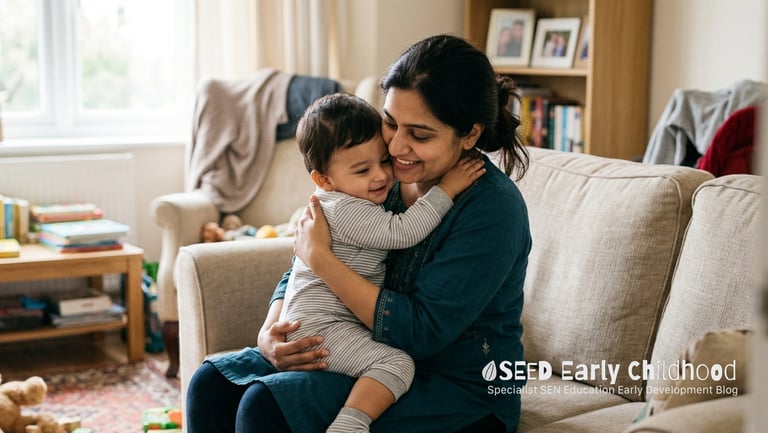

Image credit: AI. Mother and child embrace.
How do you define ‘healthy’? - Is it purely physical?
According to the Cambridge dictionary ‘healthy’ means: ‘Strong and well.’
“Your health is not only your physical side (bones, muscles, or heart) but also your mental state. If one doesn’t function properly, it will affect the other one. We need to learn how to look after both, so that we can have a long, fulfilling life.”
What is your philosophy when time is the obstacle?
“Personally, I think if something is very important to you, you will find the time for it. You may need to change some things in your busy schedule or find a way to manage it so that it will be more beneficial to achieve your goal. Small or big. It may be difficult and not easy in the beginning, but our bodies will adapt to every change over time. Persistence is the engine that will get you there.”
What does a realistic programme look like for a parent with a spare 3 hours per week?
“It all depends on the person and the goal you want to achieve. With only three hours a week, you want to hit the whole body and use as many muscles as possible at the same time. You could do three one-hour workouts or 20+ minutes each day. The goal is to maximise results through compound exercises, high-intensity interval training and active recovery.”
How long before someone can start noticing a real difference?
“It usually takes a couple of weeks to notice physical changes, but you should feel better straight away after your first workout due to the release of endorphins and improved blood flow. Your mood and energy levels can improve in 1-2 weeks. After week 3-4, you should notice that you can lift a bit more or exercises just feel easier. By week 12, others may notice a significant transformation in fat loss and muscle gain”.
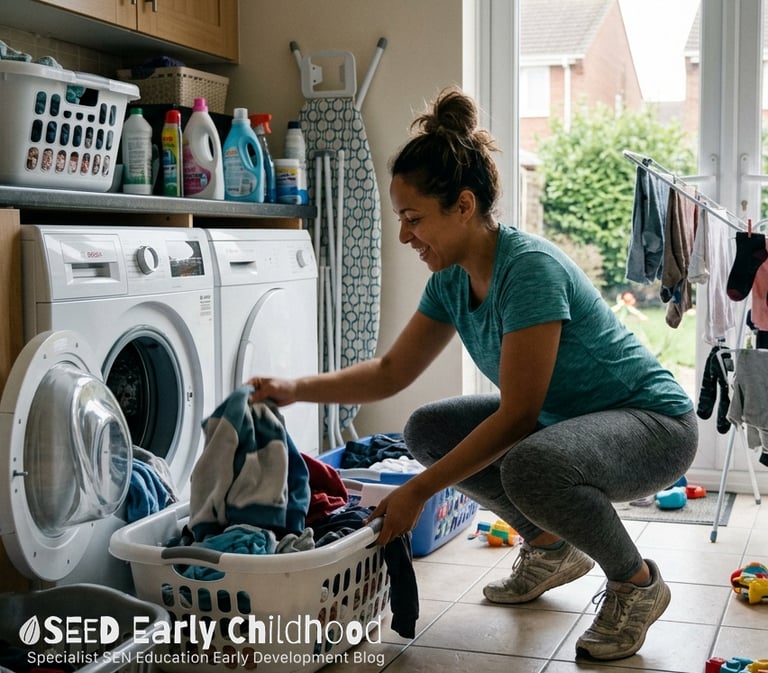
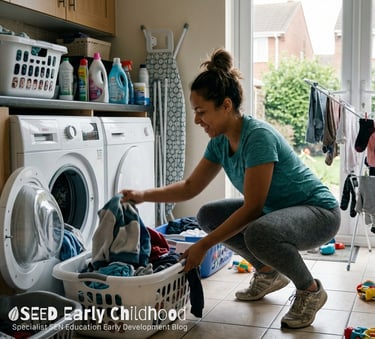
Image credit: AI. Mother does squats while doing the laundry
What is the minimum effective amount of exercise?
“Research shows that as long as you maintain intensity, you can reduce the volume by up to two-thirds for several weeks without losing your progress. Doing 1 session of 30-45 minutes of strength workout focusing on the major muscle group (squat, push, pull), 2 sessions of 10-20 minutes high intensity interval (HIIT) can maintain your aerobic base. If, for any reason, you can’t find time for those, perform 5-minute bursts of activity through the day whenever you can. (running upstairs or doing lunges or squats while the kettle is on).”
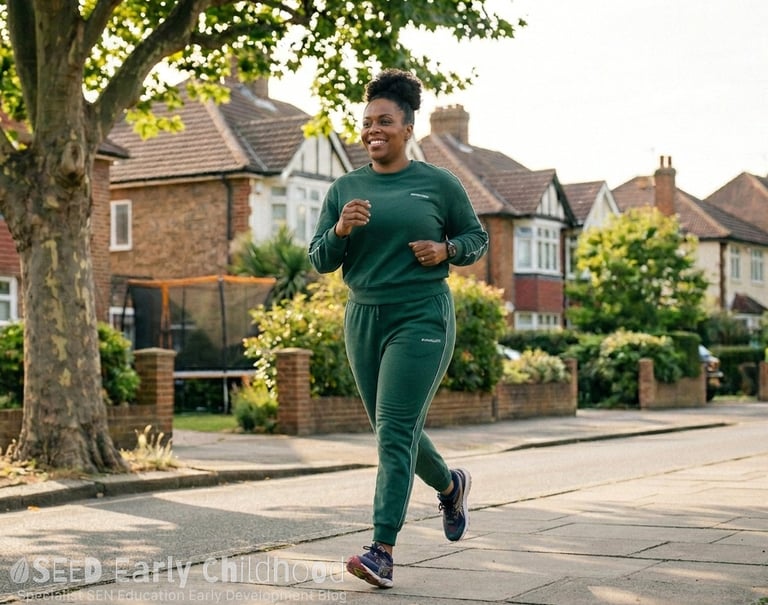
Image credit: AI. Mother runs around down her road.
What kills momentum most – and how do you rebuild after a long break
“When you are a busy parent and only have 3 hours a week to work out, it's easy to feel that if you can't do a full 30 minutes ‘properly’, there is no point in doing it at all. This mindset is wrong. Instead - having a ready ‘Go -to’ short 10-15-minute workout may be a better idea.
I myself struggled with an ‘all or nothing’ mentality, and the idea of not being able to shower straight after my gym workout was a big no-no. Which would take me another 30 minutes of my precious time I didn’t have. I had to choose between having smelly armpits and red lobster face for two more hours or losing my fitness progress by not working out at all.
Rebuilding the momentum after a long break is about setting smaller goals that are impossible to fail. For example, for first week instead of 30 minute HIIT session, commit to 5 minutes of movement every day. This can be a brisk walk around the block or three sets of squats. This way, you re-establish the routine and will re-create the habit.”
What can help someone if they miss a session?
“First is don’t panic. Missing a session is a normal part of being a busy parent. Also, one missed workout won't ruin your progress. But the goal is to stay focused and try to make sure that one missed day doesn’t turn into a missed week”.
Parents addressing their fitness and well-being is crucial for their own mental health and well-being, but also that of their child(ren). This also impacts child development. Being flexible and thinking outside the box can both support consistency and your journey to a healthier lifestyle.
Authors: Alexandra Ferreira and Samantha Donnelly BA (Hons) MA


SEED Early Childhood is the Educational blog founded by Samantha Donnelly to bring professional knowledge to you.
Alexandra Ferreira is a qualified personal trainer.
Samantha Donnelly is an Early Childhood Practitioner with more than 15 years of experience working with children, specialising in Early Childhood Education. Samantha is the founder of SEED Early Childhood Educational Blog.
References
1 Michals, S. and Reeder, K. (2023) Parental Mental Health Impacts a Child’s Well-being: Parent-focused Interventions Can Help. Journal of Student Research. 12. http://doi.org/10.47611/jsrhs.v12i3.4608.
2 Holland CJ, Cole M, Owens J Exercise and mental health: a vital connection British Journal of Sports Medicine 2024;58:691-692.
3 Cambridge Dictionary HEALTHY English meaning, Available at: Dictionaryhttps://dictionary.cambridge.org/dictionary/english/healthy
Share this post
Keep reading
Learn more about Autism, Early Development and Early Education
SEED Early Childhood Educational Blog
© 2026 SEED Early Childhood. All rights reserved. SEED Early Childhood is an Education Blog. Your use of this site is governed by our Terms and Conditions and Privacy Policy. Our website, blog services, content, and products are for informational purposes only. SEED Early Childhood does not provide medical advice, diagnosis, or treatment. See additional information.
Stay updated, subscribe to the newsletter.
SEED Early Childhood Guest Contributors
Educational Topics
Social Channels
Follow SEED Early Childhood on Social Media