
Social-Emotional Learning (SEL)
SEED Early Childhood Educational Blog
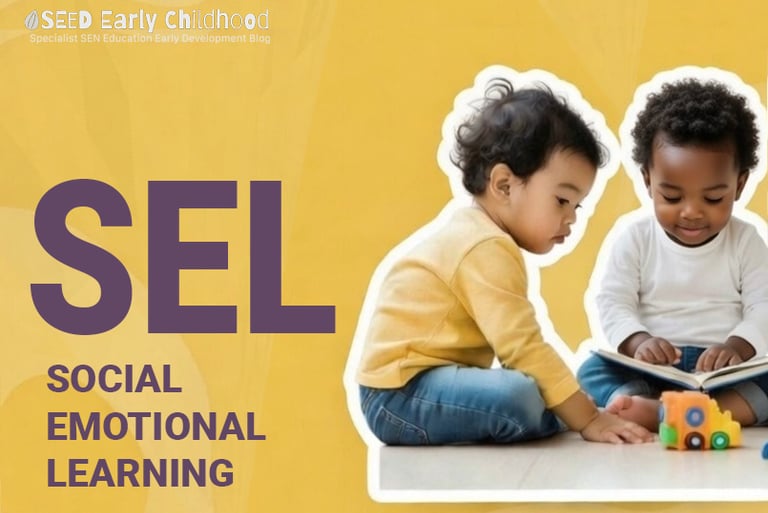
How do children develop social skills? What skills do they have at such a young age? These questions and more answered.
Keywords: Social-Emotional Learning Development Early Years Social Skills SEL Behaviour
Author Samantha Donnelly
19 February 2026


Over the years, a huge amount of research has been carried out focusing on social-emotional development in children. [6]
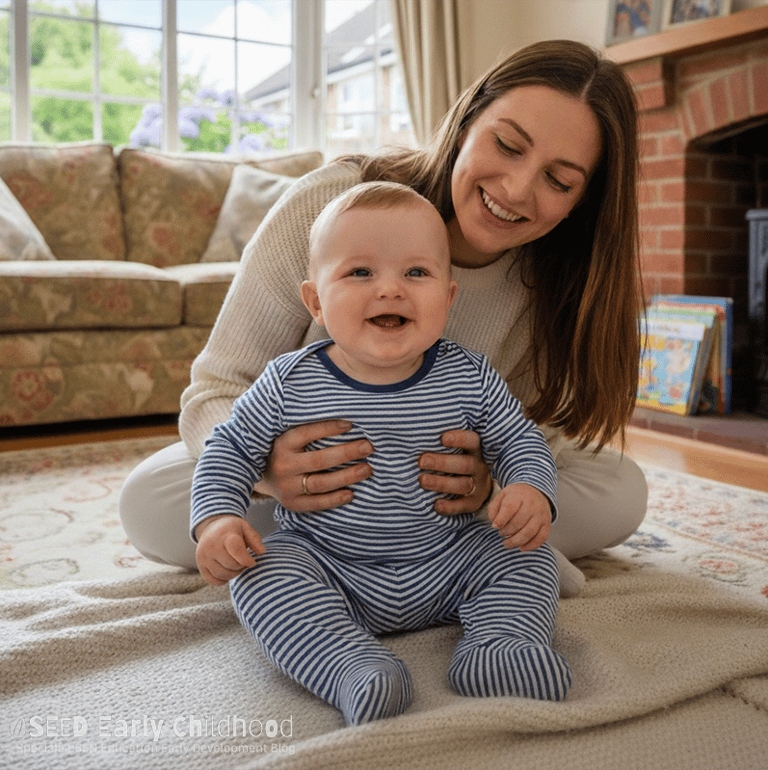
Image credit: AI. Mother and happy baby.
Children’s Early Social-Emotional Skills
The early years, 0-5 years old, are said to be the key years for acquiring Social-Emotional Learning (SEL). Depending on the child’s ability and level of development, there is an opportunity for a child to learn various social skills and behaviours. Research suggests that children can:
Identify and express emotions
Self-regulate
Cooperate socially
Build positive relationships with adults.
Social-emotional skills are key to developing: Emotional understanding, Emotional intelligence, Good coping skills, Effective interactions and Emotional expression. Social-emotional skills are key to Social-Emotional Learning and are believed to positively impact many areas of a child’s life, potentially leading to:
Better self-confidence
Increased empathy
Strong relationships
Decreased emotional distress
Positive attitude
Less externalised behaviours
Resilience
Improved self-regulation [7][5][1][2]
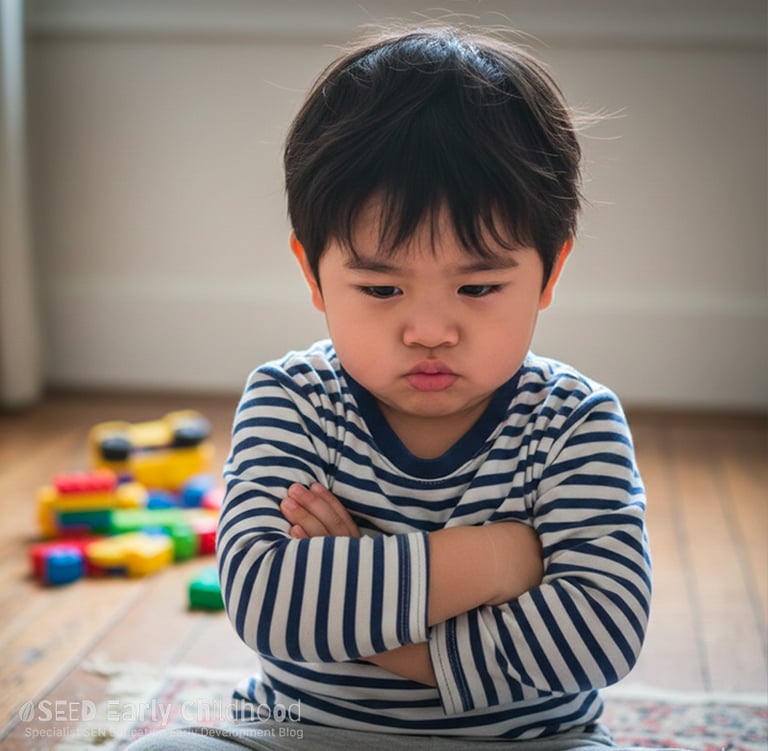
Image credit: AI. Toddler sulking.
Supporting Children’s Social-Emotional Development
When supporting children with their social-emotional development, it is important to consider:
Their age and stage of development
The child’s temperament
External factors.
In their early years, children have not yet developed abstract and symbolic thinking. They will be in the process of learning about social interactions with persons outside of their family. They are also still developing emotionally, and although they may grasp some emotions and feelings, they may have a limited vocabulary to verbalise them. Pre-schoolers may understand the basic language for emotions, but more complex emotional language, such as ‘thrilled’ or ‘tense’ may be outside of their knowledge. [6][2][7]
Developmental Delay
Children who may be delayed in their development or have a disability will need additional support to build social skills and behaviours. Research shows that delays in social skills in a child’s early years can contribute to educational, emotional and behavioural problems later in life. The preschool years are also crucial for the development of social and emotional skills, such as empathy, communication, and self-regulation. Children with delays in their social-emotional learning may struggle with tasks that require self-reflection or the ability to interpret social situations and the feelings associated with them. [2][7]
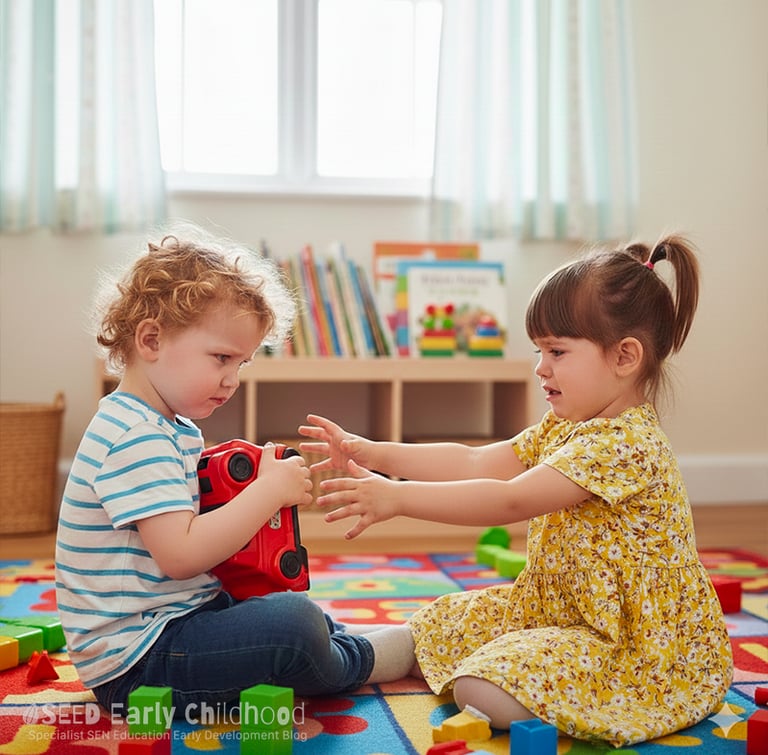
Image credit: AI. Two three year olds one child won't share.
Sharing
Sharing is a prosocial behaviour and does not properly develop until the child is around 4 years old. Behaviour such as sharing is essential for social-emotional development, peer interaction, and collaboration. Learning to cooperate with peers is an important skill, as many children will transition into school settings and will need to engage with children who are not familiar to them. Younger children tend to be very possessive and struggle to share. Consideration of the child’s age will shape the level of support they require.
Sharing is a very complex behaviour for a child to grasp. It requires:
Working memory
Perspective
Inhibitory control
Cognitive flexibility
Reflective thinking
When children learn to share, they can develop social awareness and build relationships which can positively impact their well-being. [2][1]
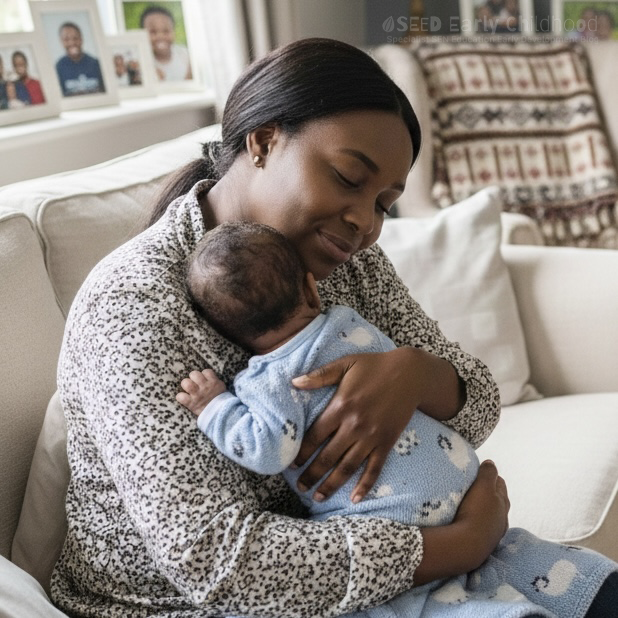
Image credit: AI. Mother holds her baby.
Adults' Impact on Children’s Social-Emotional Development
Small children have many needs that must be met in order to develop social-emotional skills and behaviours. The adults around them play a huge part in their social-emotional development. The adult role involves:
Nurture
Responsiveness
Being a role model [2][7][1]


Parents
Research studies have identified that parents' practices played an important role in their child’s development of social skills. The well-being of the parent has been found to impact behaviour and the child’s social-emotional learning. This is thought to be because parents are the child’s first point of learning.
One study [13] found that a positive family environment was an important factor for the development of social skills. The way the child is parented also impacts their social-emotional learning. Research suggests that authoritative and supportive parenting styles were linked with better emotional regulation and reduced internalising and externalising behaviour. Heightened psychological problems were linked to disengaged parents and the lack of social support.
Research highlights the possible differences in the way girls respond to social support compared to boys, stating that girls were responsive to relational elements of support, whereas boys responded to the practical aspects. However, future research is needed to better understand these differences between the sexes.
Social support can help children to feel good about themselves. This is central to the child’s ability to develop social competence, having the ability to express their feelings, show empathy and share. Cooperation is a skill which grows through experience. Children who are provided opportunities to interact socially can learn about interactions, and they can also begin to develop social problem-solving skills. [13][2][8][1]
Some Preschool-aged children will gain their first experiences of socialising from educational environments, too.
Early Childhood Education and Care (ECEC) Settings
Every group-based Early Childhood Education and Care setting, including child minders, will follow the mandatory statutory Early Years Framework, based on the Childcare Act 2006. The framework describes the areas of Learning and development; these areas have two subcategories: Prime Areas and Specific Areas. All the areas are interconnected. The prime areas are:
Communication and language
Physical development
Personal, social and emotional development
The specific areas are:
Literacy
Mathematics
Understanding the world
Expressive arts and design
The three prime areas form the foundation for children’s learning and are especially important for forming relationships.
As some children spend a lot of time in Early Childhood Education and Care settings before transitioning to school, these environments play an important role in the development and improvement of social-emotional skills. The quality of the educators will impact this. One study [11] found that children taught by more experienced educators gained better social skills scores in the research findings. When there is a lack of understanding about the importance of social-emotional learning, a focus on achievement in academic areas can cause these important skills to be neglected. A study found that children who scored as stable-low on social skills had an increased risk of poor primary school performance, and those with stable-high social skills had an increased chance of good primary school performance. [8][14][13]
Extra support
Some children may need additional support as they are struggling with social-emotional issues. Challenges can include:
Attachment problems
Trauma
Disability
Mental health problems
There is strong evidence that social-emotional development can be supported by interventions in the early years educational setting. When difficulties are recognised, the professionals can intervene to support a child. Understanding the needs of pre-schoolers and providing the required interventions establishes the foundations of general development and can support the transition to school.
Intervention programs can support school transition by:
Focusing on specific skills
Fostering relationships with adults
Improving general skills
Focusing on behaviours
Supporting and improving learning capabilities
Promoting social engagement. [2][4][7]
References
1 Tan, E., & G, K. (2024). Building prosocial behaviours: Examining the possibilities of social stories in early childhood classroom settings. https://doi.org/10.1177/1476718X241227044
2 By Kendra C. (2025) Social and Emotional Development in Early Childhood How Kids Learn to Share and Care
3 Hosokawa, R., Matsumoto, Y., Nishida, C., Funato, K., & Mitani, A. (2024). Enhancing social-emotional skills in early childhood: intervention study on the effectiveness of social and emotional learning https://doi.org/10.1186/s40359-024-02280-w
4 Martikainen, S., Kalland, M., Linnavalli, T., Kostilainen, K., Aittokoski, M., Reunamo, J., … Tervaniemi, M. (2024). Supporting social-emotional development in early childhood education and care – a randomized parallel group trial evaluating the impact of two different interventions. https://doi.org/10.1080/00313831.2023.2204119
5 Walog, R., Revalde, H., Duites, A.C., Opingo, K.M., Mangubat, R., & Espina, R. (2024). Building Social-Emotional Foundations in Early Childhood Education: Approaches and Outcomes. https://doi.org /10.32996/jhsss.2024.6.9.16
6 Djamnezhad Dariush , Koltcheva Nadia , Dizdarevic Alma , Mujezinovic Amila , Peixoto Carla , Coelho Vera , Achten Mart , Kolumbán Erika , Machado Francisco , Hofvander Björn (2021) Social and Emotional Learning in Preschool Settings: A Systematic Map of Systematic Reviews https://10.3389/feduc.2021.691670
7 Aksoy, P. & Gresham, F. M. (2024). Evidence-based social-emotional learning intervention programs for preschool children: An important key to development and learning. https://dx.doi.org/10.52380/ijpes.2024.11.3.1227
8 Hosokawa, R., Matsumoto, Y., Nishida, C. et al. Enhancing social-emotional skills in early childhood: intervention study on the effectiveness of social and emotional learning. BMC Psychol 12, 761 (2024). https://doi.org/10.1186/s40359-024-02280-w
9 Carol Gray Social Stories Social Stories™
https://carolgraysocialstories.com/social-stories/
10 Carol Gray Social Stories What is a Social Story?
https://carolgraysocialstories.com/social-stories/what-is-a-social-story/
11 Maleki, M., Mardani, A., Chehrzad, M. M., Dianatinasab, M., & Vaismoradi, M. (2019). Social Skills in Children at Home and in Preschool. Behavioral Sciences, 9(7), 74. https://doi.org/10.3390/bs9070074
12 Walog, Rechael & Revalde, Helen & Duites, Adrian & Opingo, Kaitlin Marie & Mangubat, Randy & Espina, Raymond. (2024). Building Social-Emotional Foundations in Early Childhood Education: Approaches and Outcomes. Journal of Humanities and Social Sciences Studies. 6. 144-150. 10.32996/jhsss.2024.6.9.16.
13 Frogner, L., Hellfeldt, K., Ångström, A. K., Andershed, A. K., Källström, Å., Fanti, K. A., & Andershed, H. (2022). Stability and Change in Early Social Skills Development in Relation to Early School Performance: A Longitudinal Study of A Swedish Cohort. Early Education and Development, 33(1), 17–37. https://doi.org/10.1080/10409289.2020.1857989
14 Department for Education Early Years Foundation Stage Statutory Framework (2025) For group and school-based providers EYFS statutory framework for group and school-based providers
15 Kington, A., Gates, P., & Sammons, P. (2013). Development of social relationships, interactions and behaviours in early education settings. Journal of Early Childhood Research. https://doi.org/10.1177/1476718X13492936
Author: Samantha Donnelly BA(Hons) MA
Samantha Donnelly is an early childhood professional with more than 15 years of experience working with children, specialising in Early Childhood Education. Samantha is the founder of SEED Early Childhood Educational Blog.
SEED Early Childhood is an independent educational blog created with this mission: to provide free, professional insights into child development and education for parents.
SEED Early Childhood is the Educational blog founded by Samantha Donnelly to bring professionals to you.
Share this post
SEED Early Childhood Educational Blog
© 2026 SEED Early Childhood. All rights reserved. SEED Early Childhood is an Education Blog. Your use of this site is governed by our Terms and Conditions and Privacy Policy. Our website, blog services, content, and products are for informational purposes only. SEED Early Childhood does not provide medical advice, diagnosis, or treatment. See additional information.
Stay updated, subscribe to the newsletter.
SEED Early Childhood Guest Contributors
Educational Topics
Social Channels
Follow SEED Early Childhood on Social Media