
The World Is the Classroom: Golden Learning Moments We’re Missing
Sakinah Muhammad and SEED Early Childhood
SEED Early Childhood Educational Blog


Written by:
Are there many options for learning in this fast-paced world? Did you know learning can happen in the supermarket? Read on for insights into practical learning on the go.
17 July 2026


SEED Early Childhood
Sakinah Muhammad

Reviewed by Samantha Donnelly BA (Hons) MA
This post is authored by Sakinah Muhammad and SEED Early Childhood. Sakinah is a qualified Level 3 Early Years Educator with over 10 years of experience working in Early Childhood Education and Care (ECEC), specialising in children aged 18 months to 5 years. SEED Early Childhood is an independent educational blog created with this mission: to provide free, professional insights into child development and education for parents.
In today’s fast-paced world, it’s easy to hand a child a device while we shop, commute, or run errands. Screens can feel like the simplest solution. But what if we’re missing something extraordinary?


The Supermarket: A Hidden Classroom
What if the supermarket aisle, the walk to school, or the train ride across town holds richer learning opportunities than any app ever could?
The world is a school. School is not just the one children attend from 9–3 but the living, breathing classroom all around them.
A trip to the supermarket is a masterclass in real-world learning. Instead of scrolling on a device, children can:
"The world is a school."
Create a Visual Shopping List
For early learners, drawing pictures of items needed: a banana, milk, bread. At the shop, let them match the drawing to the real item. This can build:
Visual description
Early reading readiness
Memory skills
Counting and Comparing
Examples:
“We need 6 apples — can you count them into the bag?”
“Which is heavier — the small pumpkin or the big one?”
“Which yoghurt costs less?”
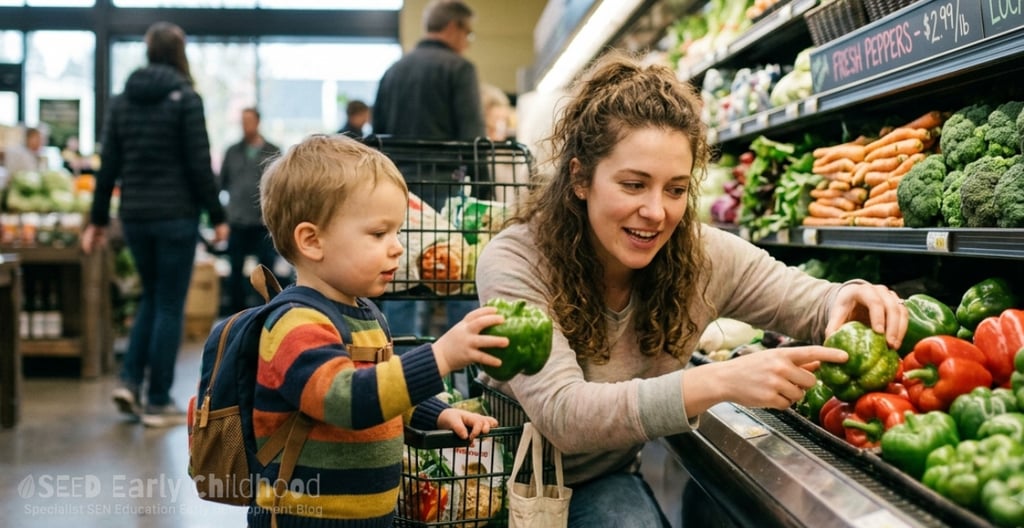
Image credit: AI. Mother and child at the supermarket.
Money and Budgeting
This introduces:
Counting
One-to-one correspondence
Weight and size comparison
Early maths language (more, less, heavier, lighter)
Depending on age and stage, children can:
Hand money to the cashier
Look at prices
Compare value
Learn that money is exchanged for goods
That’s financial literacy in real life.
Walking: Literacy in Motion
A simple walk is full of golden learning. Children begin to understand that print has meaning. Numbers are everywhere. Sounds tell stories. The environment becomes interactive.
Point out:
House numbers
Letters on signs
Shop names
Road markings
Trains and Buses: Learning on the Move
Ask:
“Can you spot the letter S?”
“What number comes after 5?”
“What sound does that bus make?”
Public transport is rich with opportunity.
On the train:
Play “I Spy”
Look at maps together
Trace the journey with a finger
Tick off stations as you pass them
Draw what you see out the window
Bring paper and pens instead of a screen.
You can:
Sketch the train
Draw passengers
Copy symbols from signs
Create your own simple map
This builds:
Observation skills
Early geography awareness
Fine motor skills
Focus and patience
And perhaps most importantly, conversation.
Sensory Learning is Real Learning
Children need to touch, feel, smell, listen, and move.
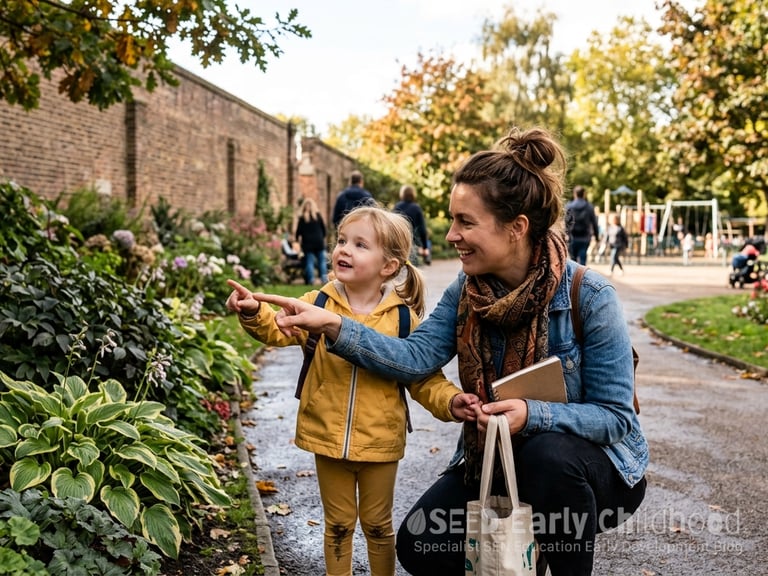
Image credit: AI. Mother and daughter explore outdoords.
Feel the rough bark of a tree
Notice the smell of the bakery
Listen for birds
Compare textures of fruit
Carry a small bag and feel its weight change
These sensory experiences build neural connections that screens simply cannot replicate.
According to the new official guidance, total screen time for young children should be limited as much as possible. Children under 2 years old should only engage in screen time when it is co-viewing, developmentally encouraging, i.e., supporting interaction, conversation, and engagement with their family. And between the ages of 2-5 years, aim for under an hour a day. [2][3]
Technology has its place. But when devices replace real-world interaction during everyday moments, we miss golden opportunities for growth.
It's not about Removing Screens Completely


The World is the Curriculum
Learning doesn’t only happen at a desk or in a classroom
It doesn’t require worksheets.
It doesn’t need to be scheduled.
It’s happening constantly if we slow down enough to notice.
Every errand.
Every journey.
Every queue.
Every walk.
These are not “in-between” moments to be filled with distraction. They are invitations to connect, to wonder, to question, to learn. When we involve children in real-life experiences, we’re not just keeping them busy; we’re building thinkers, observers, problem-solvers, and communicators.
The world is a school.
Let’s use it.
Authors: Sakinah Muhammad and SEED Early Childhood

SEED Early Childhood is the Educational blog founded by Samantha Donnelly to bring professional knowledge to you.
Sakinah Muhammad is a qualified Level 3 Early Years Educator with over 10 years of experience working in Early Childhood Education and Care (ECEC), specialising in ages 18 months to 5 years.
SEED Early Childhood is an independent educational blog created with this mission: to provide free, professional insights into child development and education for parents.


References
[1] Kiviranta, L., Lindfors, E., Rönkkö, M. L., & Luukka, E. (2024). Outdoor learning in early childhood education: exploring benefits and challenges. Educational Research, 66(1), 102–119. https://doi.org/10.1080/00131881.2023.2285762
[2] Screen time guidance for under 5s https://beststartinlife.gov.uk/screen-time-under-5s/
[3] New screen time guidance for parents of under-5s https://www.gov.uk/government/news/new-screen-time-guidance-for-parents-of-under-5s
Share this post
Keep reading
Learn more about Autism, Early Development and Early Education
SEED Early Childhood Educational Blog
© 2026 SEED Early Childhood. All rights reserved. SEED Early Childhood is an Education Blog. Your use of this site is governed by our Terms and Conditions and Privacy Policy. Our website, blog services, content, and products are for informational purposes only. SEED Early Childhood does not provide medical advice, diagnosis, or treatment. See additional information.
Stay updated, subscribe to the newsletter.
SEED Early Childhood Guest Contributors
Educational Topics
Social Channels
Follow SEED Early Childhood on Social Media
Special Educational Need (SEN)
© 2026 SEED Early Childhood Samantha Donnelly BA (Hons), MA (Sole Trader) (T/A) SEED Early Childhood
© 2026 SEED Early Childhood Samantha Donnelly BA (Hons), MA (Sole Trader) (T/A) SEED Early Childhood 204 Milne Building, Heritage Lane, NW6 2AF samantha@seedearlychildhood.com
© 2026 SEED Early Childhood. All rights reserved. SEED Early Childhood is an Education Blog. Your use of this site is governed by our Terms and Conditions and Privacy Policy. Our website, blog services, content, and products are for informational purposes only. SEED Early Childhood does not provide medical advice, diagnosis, or treatment. See additional information.